Getting started
Fuenlabrada is one of a series of satellite conurbations encircling the Spanish capital. Designed as a dormitory town to serve Madrid’s growing economy in the 60s and 70s, its population dramatically increased as the capital sucked in people from all over Spain. Fast forward to today, and Fuenla faces many of the urban challenges of 21st century Europe, including:
- Lack of affordable housing
- an ageing population
- rising levels of youth unemployment
Of course, each city has to approach these systemic challenges in its own way. It also has to optimize the assets it has at its disposal. In the case of Fuenlabrada, this includes a strong and stable political leadership; high levels of social solidarity within the local community and an international attitude which encourages collaborative approaches to problem solving.
As Alba Iglesias Clavijo from the Fuenla international Team puts it:
”The city has a strong tradition in city twinning, identifying EU opportunities, and managing EU projects. Since our Mayor Mr. Javier Ayala governed, the promotion of European initiatives has increased significantly. He actively encourages us to establish new and strong connections with other national and European municipalities. Additionally, since our department is part of his office and under his leadership, it is easier to secure support from other departments.”
In the current EU programming period, this set of attributes has served the city well as It has sought to navigate the available urban innovation support structures. In particular, mechanisms enabling the transfer of ideas and effective solutions have been on its radar.
What they have done
How has this translated on the ground? A quick round up of the city’s current and recent activities provides insights into their focus, as well as into their energy levels and scale of ambition.
Over the past three years, Fuenlabrada has:
- Successfully secured EUI Innovative Actions funding to develop a highly innovative inter-generational affordable housing model, under the banner of the SHARE project. Inspired by the New European Bauhaus, the city will establish a state of the art ‘living centre’ for older people, whose vacated premises will be made available to young people in the city lacking affordable accommodation. SHARE is in the first wave of new IA projects with an in-built transfer component, where three other cities (Vilnius, Teramo and Larissa) are exploring ways to adapt the Fuenla model to their own local context.
- Embarked on another transfer journey as part of the URBACT Innovation Transfer Network (ITN) Cities 4 Co-housing, which seeks to adapt and reuse the learnings from the CALICO housing project developed by Brussels in the first generation of Innovative Actions projects. Here, Fuenla is one of 5 Transfer Partners, working together to share effective lessons relating to affordable housing.
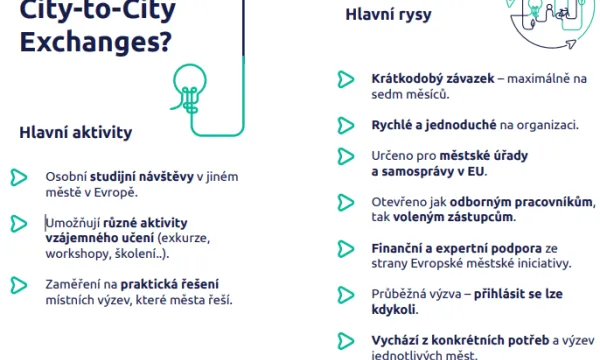
- Participated in the EUI City to City Exchange with the small Czech city of Zlín, which utilised this opportunity to explore the Fuenla’s affordable housing approach in greater detail. Vilnius made up the third partner in this city-to-city experience, thereby deepening the Spanish city’s existing links with the Lithuanian capital. These structured exchanges offer rich professional development and learning opportunities for city staff and stakeholders alike.
- Hosted the EUI Policy Lab on Cities for housing: making affordable and social housing work that took place in early November 2025. Over two days, this headline event attracted Europe’s leading thinkers and practitioners in the field, focused on sharing effective practices and exploring ways to promote the affordable housing solutions so many cities need.
The challenges faced
So far so good, and this list of achievements - attracting resources, talent and connections - sounds like it has come easy to Fuenlabrada. But what’s the real story? What has the city learned along the way that might help other small cities coming behind them.
In conversation with the Fuenlabrada team, they are quick to explain that it hasn’t all been plain sailing. As a small municipality, their biggest challenges have related to the administrative burden. However, these have had less to do with EU regulations and more with their own national tendering and procurement processes. Although at times stressful, the team hopes that pushing new boundaries on implementation will drive change within the wider municipality.
The distinctive role of the Fuenlabrada EU team gives it a special relationship with other departments, as Alba noted:
“We usually have the support of other departments; however, our role is more externally focused than that of other teams, as we serve as the city’s primary “EU face.”
What about the benefits?
It might be easy to look at Fuenlabrada and think that this is simply about finance. Securing external funding is important, of course, especially when it enables significant levels of innovation. But this is not only about money.
The wider benefits are, perhaps, just as important. The team explained that:
“As a city actively engaged in housing-related challenges, hosting the Policy Lab offered a valuable opportunity to meet leading experts and municipalities with significant experience in this field. We are truly grateful to the EUI for bringing such outstanding panelists to our city, and we were delighted to benefit from their insights, perspectives, and inspiring contributions.”
This exposure to other leading cities in the field is helping Fuenlabrada to rethink its own approach, and consider its future options. As they noted in our exchange:
“The importance of municipalities retaining ownership of land or housing units when promoting public housing, in order to prevent speculation -as demonstrated by the Vienna model- has been a key lesson for us.”
What smaller cities can take away from this
They say that success breeds success. That has certainly been the case for Fuenlabrada, which is now at the top table with cities across Europe leading the charge on the development of affordable housing solutions. For a small city like this, the achievement is really significant.
Of course it’s not alone. If we look across Europe, we can see other smaller cities punching above their weight. So, what’s the secret? What hints and tips does Fuenla have for others hoping to follow in its footsteps? Let’s give the final word on this to the city’s International Team, whose advice is that peer cities should:
“Be strategic when applying to different calls, and actively seek synergies between projects to generate shared learnings and maximise impact.”
This sounds like good advice, especially for cities with limited Human Resources who need to prioritise and use their internal resources efficiently. Follow it and who knows, your city could be the next Fuenlabrada.