Zentropy MICE Urban Diary – Insights from the field Chapter 1 – (Year 1, 2025)

This first chapter of the Urban Diary for the Zentropy MICE - Valencia project documents how, during its foundational year (2025), the activities evolved from a conceptual ambition into a shared, operational framework for systemic urban transformation through the MICE sector. It frames congresses as temporary accelerators of urban Energy, Matter and Information flows and introduces urban entropy as a lens to reorganise these exchanges toward long-term value creation. The chapter reflects on the collective learning process required to translate this paradigm into practice, highlighting the importance of alignment, coordination and shared mental models among partners. It presents the integrated innovation model—spanning ecosystem characterisation, measurement, infrastructure optimisation and legacy creation—and captures early insights from each innovation block, including the development of the Entropy Calculator and the reframing of legacy as a transversal driver. Overall, Year 1 establishes the methodological and governance foundations for scaling impact and transferability in the years ahead.
1. Framing the journey
Over the last decade, the MICE sector has consolidated its role as a powerful economic engine for European cities. Congresses and large-scale events generate significant direct and indirect economic value, position cities internationally, and activate entire urban ecosystems—from hospitality and mobility to knowledge and innovation networks. At the same time, they concentrate and multiply environmental pressures, intensifying energy consumption, material use, waste generation, and mobility-related emissions over very short periods of time.
Despite this dual reality, sustainability approaches in the MICE sector have largely remained incremental and fragmented. Environmental impacts are partially measured—often reduced to carbon footprints—while social impacts and longer-term socio-economic value for host cities remain weakly articulated, rarely measured, and seldom maximised. The city is still too often treated as a backdrop rather than as an active system interacting with events.
Zentropy MICE emerges precisely at this crossroads. The project starts from a simple but powerful premise: congresses are not isolated events, but temporary accelerators of urban flows. They intensify exchanges of Energy, Matter and Information with the city, increasing urban entropy when these flows are poorly organised, and creating shared value when they are intentionally structured.
The higher the urban entropy, the greater the waste of flows. Reducing entropy means reorganising exchanges to generate value instead of loss.
After almost one year of implementation, Zentropy MICE has evolved from an ambitious conceptual proposal into a living urban experiment. This chapter marks the first reflective pause in that journey. This first chapter of the Urban Diary captures how the project has been shaped by practice, how assumptions have been tested and refined, and how learning has emerged from real governance, technical and cultural challenges.
Year 1 (2025) has been a foundational year, focused on alignment with all partners (Valencia’s City Council, Valencia Conference Center, Valencia Innovation Capital, Universitat Politècnica de València, Visit València and Khora Urban Thinkers), shared understanding and methodological consolidation. It sets the baseline for the following chapters, ensuring continuity (until 2028) while allowing the project’s innovative elements to evolve over time.
2. From concept to collective understanding
Zentropy MICE was designed as a systemic response to a long-standing challenge in the MICE sector:
How to address the full spectrum of Energy, Matter and Information impacts generated by congresses moving beyond standalone sustainability solutions.
The project introduces the concept of urban entropy, inspired by principles of thermodynamics, as an organising framework to understand and restructure the disorder generated by MICE-related flows. Congresses are understood as open systems that exchange Energy, Matter and Information with the city, reducing waste and amplifying value.
Year 1 made clear that translating this paradigm into practice required a shared mental model among Partners. And more importantly, the novelty of the entropy-based approach required time, dialogue and iteration to be collectively understood and appropriated.
This challenge was mitigated by an important underlying strength of Zentropy MICE: the partnership was not starting from zero. Many partners had already collaborated in previous European and local projects, sharing working cultures, trust, and complementary expertise. The collaborative engine was therefore already in place; what was needed was to recalibrate it around a new conceptual framework and a more systemic ambition.
Coordination meetings as a catalyst for alignment
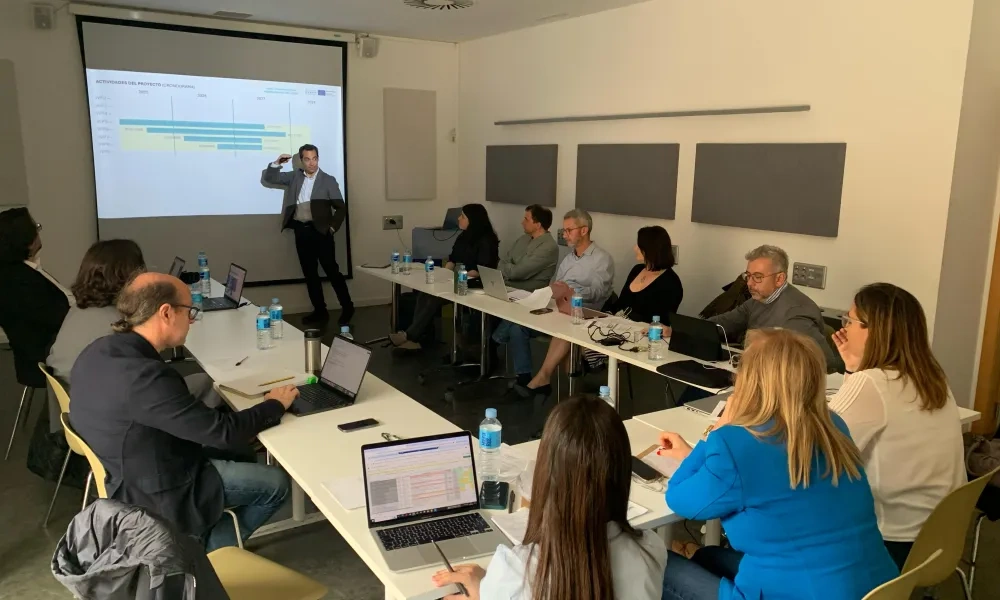
Within this context, the first global partnership meeting held in April 2025 (with the participation of the IA Expert), played a catalytic role. Rather than being an isolated milestone, it functioned as an action lever to accelerate collective understanding.
The meeting provided a structured space for partners to:
- Share their interpretations of the entropy concept and its implications for their respective roles.
- Bring forward existing datasets, programmes, tools and prior experiences relevant to MICE sustainability.
- Identify overlaps, complementarities and gaps across work packages.
Given the high level of interdependency between work packages and the need for data traceability, these moments emerged as essential to translate the project’s conceptual ambition into operational reality.
In systemic innovation projects, coordination meetings are not an administrative burden; they are a core implementation tool. Their strategic use in the following year is expected to significantly strengthen learning and coherence.
3. The Innovative Model behind Zentropy MICE
At the core of Zentropy MICE lies not a single tool or pilot intervention, but an integrated innovation model designed to transform how cities understand, manage, and create long-term value (the “legacy”) from MICE activities. What makes the solution genuinely innovative is its ability to translate a complex, systemic concept (entropy) into an operational, decision-oriented framework that partners can actively use and transfer across Europe.
The project does not stop at defining principles but translates them into a sequenced implementation logic:
characterisation → measurement → optimisation → legacy
This sequence structures the project’s innovation model into a set of interconnected building blocks, each addressing a specific dimension of transformation while reinforcing the others. The table below summarises these blocks and highlights the distinctive innovation approach underpinning each of them.
Image
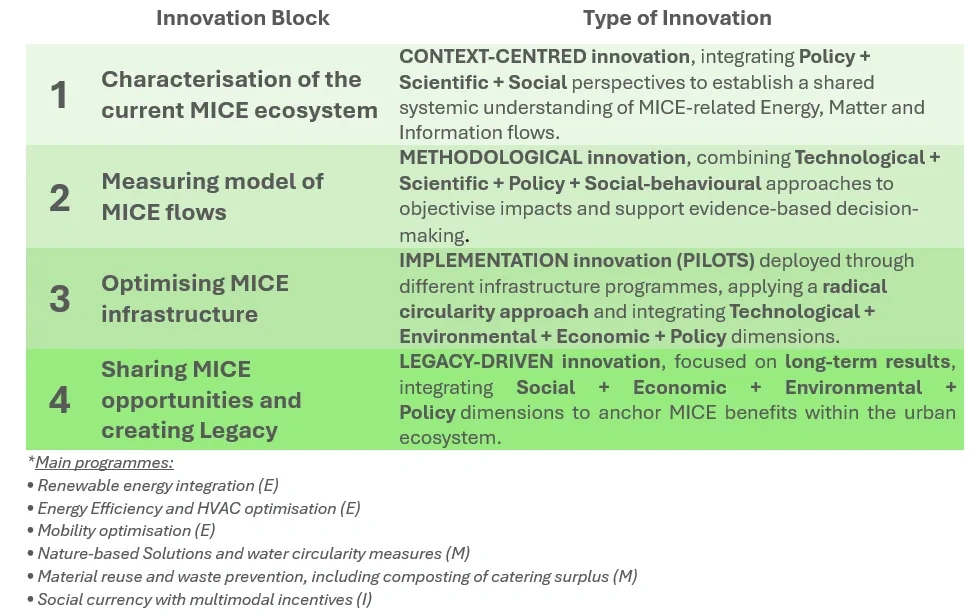
Taken together, Zentropy MICE represents an innovation that is greater than the sum of its parts. Its added value lies in its ability to hold complexity without simplifying it away, while still producing actionable guidance for replicability. Year 1 has shown that such an ambitious model requires time, coordination and iterative learning, but it has also confirmed that the city of Valencia is ready for solutions that move beyond incremental sustainability and towards systemic urban transformation.
Innovation Block 1 – Characterising the MICE Ecosystem
The first building block of the innovative model focuses on the characterisation of Valencia’s MICE ecosystem through an entropy-based lens. Technically, this activity is close to completion (95%), but its real contribution goes beyond the production of technical deliverables.
The process involved mapping the full MICE value chain, defining entropy elements and indicators, and analysing Energy, Matter, and Information flows. This work is generating not only a robust baseline, but also a profound shift in perspective among key actors.
At the level of the Valencia Conference Center, the characterisation exercise triggered an introspective process. Sustainability was no longer framed solely as an internal operational matter, but as a relational challenge connected to the city, the territory, and the wider ecosystem of stakeholders. This marked a change from an inward-looking building approach to an outward-facing urban role.
At the territorial scale, complexity became evident. Defining the system boundaries—what to include, what to exclude, and how to prioritise inputs—proved to be one of the most intellectually demanding tasks. The mapping of economic activities remains under development, and its full articulation with other project activities will be a key challenge to be addressed in Year 2.
Interviews with meeting owners revealed an unexpected yet highly valuable insight: a strong willingness to embrace a deeper transformation of the MICE model, particularly through stronger connections with legacy policies and the city’s long-term development goals. This predisposition to change created favourable conditions for the subsequent activities.
Image

Innovation Block 2 – Measuring MICE Flows: The Entropy Calculator
The development of the Entropy Calculator represents one of the most innovative and technically demanding aspects of Zentropy MICE. Conceived as the first tool globally to measure entropy in MICE beyond carbon metrics, it is designed to integrate LCA logic, Scopes 1–3, a venue digital twin, smart city datasets, mobility data, and event surveys.
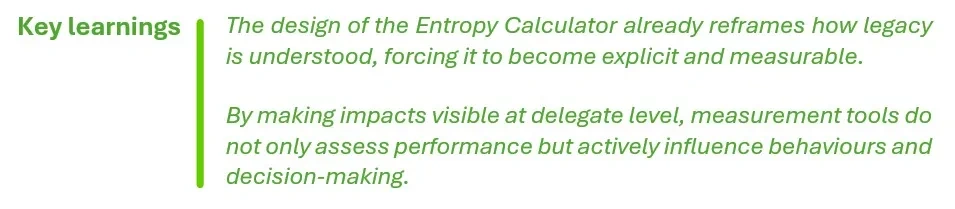
During Year 1, this building block was formally initiated, but its conceptual impact already exceeds its stage of completion. The construction of the calculator forced the partnership to confront a core difficulty: how to translate qualitative and systemic ambitions into measurable parameters, particularly regarding legacy.
While the ecosystem characterisation served to define the elements to be considered, the calculator will require legacy to be translated into clear indicators, proxies and data points meaningful to organisers and delegates. This inversion—from narrative to metric—constitutes a central challenge, which will be further developed in the coming months and progressively tested across several events, following a learning-by-doing approach (with initial tests in events linked to the UPV).
The process also raised strategic questions about usability and relevance. With five partners deeply involved and a high level of technical complexity, a recurring concern has been ensuring that at least one deliverable remains close to the end user, particularly the congress delegate. This tension between scientific robustness and operational simplicity has been reframed as an intentional design choice, rather than a problem to be avoided.
Image
Innovation Block 3 – Optimising MICE Infrastructure
The implementation of the designed infrastructure programmes is where systemic analysis meets physical reality through a radical circularity approach. In Year 1, this building block remained under definition and review, revealing the importance of timing, sequencing and co-design.
The proposed infrastructure programmes are not conceived as isolated technical upgrades, but as interconnected interventions contributing simultaneously to the optimisation of Energy, Matter and Information flows. This integrated perspective ensures that infrastructure decisions reinforce the broader Zentropy logic rather than addressing single-impact dimensions in isolation.
Some elements of the proposed interventions—such as energy efficiency measures or renewable energy options—had already been anticipated by the Valencia Conference Center. While this demonstrates institutional proactivity, it also highlighted the risk of fragmented action if initiatives are not explicitly framed within the Zentropy MICE circularity model.
As a result, the need for a dedicated co-design phase became evident. For example, the potential deployment of micro-wind turbines is currently under assessment, with sensorisation envisaged as a prerequisite to validate real Energy and Information gains before investment decisions are made.
Looking ahead, the urban innovation “sandbox” initiative promoted by the City of Valencia will act as a key enabler to accelerate implementation, allowing controlled experimentation and reducing the impact of potential administrative bottlenecks.
In parallel, Year 1 created an unexpected opportunity for international learning: Valencia’s participation in the Circular Economy Summit in Canada under the EU-funded IURC programme enabled the exchange of best practices at global level, generating insights directly relevant to Zentropy MICE. This experience also facilitated cross-departmental collaboration within the Municipality, notably with the Urban Waste department, strengthening the Matter dimension of the model.
Image

Innovation Block 4 – Legacy as a vertical lever
Perhaps the most significant evolution of this first year concerns the legacy component. Originally conceived as a discrete and ultimate activity, legacy has been reconsidered from the outset and repositioned as a vertical, cross-cutting principle shaping all work packages.
This shift represents a deliberate and strategic deviation from the original proposal, but one that significantly strengthens the project’s coherence. Legacy is no longer an outcome to be added at the end of an event; it is systematically embedded across characterisation, measurement, infrastructure design and communication activities.
This reframing acknowledges the difficulty of measuring information flows and social impact, but it also opens new pathways for meaningful urban value creation. By advancing the legacy programme earlier than planned, the project is aligning incentives, expectations, and tools from the outset.
During the Opening Site Visit with the Transfer Partners, the project highlighted how existing experience from Ljubljana—particularly its work on analysing delegate behaviour through interviews and structured data collection—can directly inform the development of the legacy dimension within Zentropy MICE.
In parallel, Valencia has expressed a strong commitment to connect with other EUI–IA projects, such as COGEN (Copenhagen), in order to exchange approaches and methodologies on legacy creation and assessment.
Image

4. Key milestones during this first year
Year 1 was punctuated by several key moments that helped consolidate Zentropy MICE both internally—among partners—and externally—within the city, the EU ecosystem, and international networks:
Image
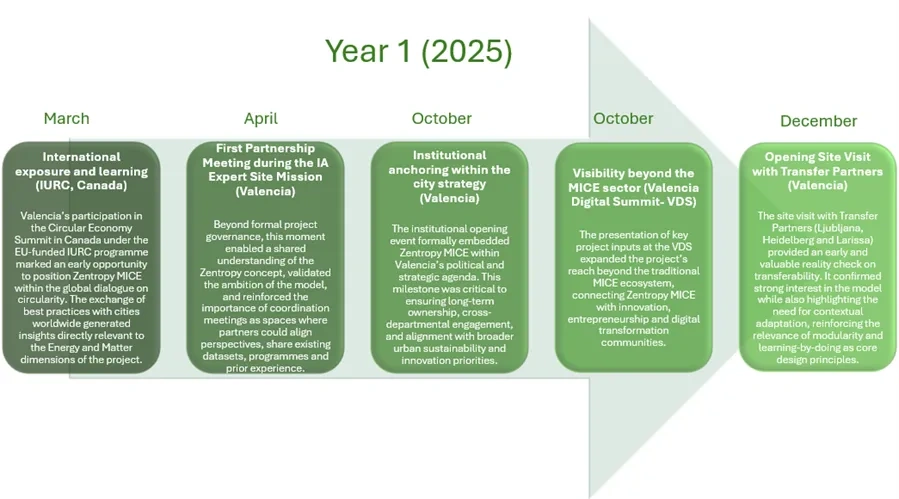
Taken together, these milestones underscored the importance of communication, narrative and storytelling as essential complements to technical implementation. Trust, shared language and the people behind each partner have proven to be foundational elements for collaboration, learning and long-term impact.
5. Reflections looking ahead
Year 1 of Zentropy MICE has been fundamentally focused on foundation-building. Alignment, shared understanding and methodological clarity have emerged as essential prerequisites for the future development.
The challenges encountered—data complexity, governance coordination, conceptual translation from entropy theory to operational practice—are intrinsic to ambitious urban transformation processes. Documenting these challenges transparently is therefore not a weakness, but a contribution in itself, providing value not only for the project, but also for other cities exploring similar pathways, particularly the Transfer Partners: Ljubljana, Heidelberg and Larissa.
Replicable starting points for other EU cities
Several core elements of Zentropy MICE have already demonstrated strong transfer potential:
Image
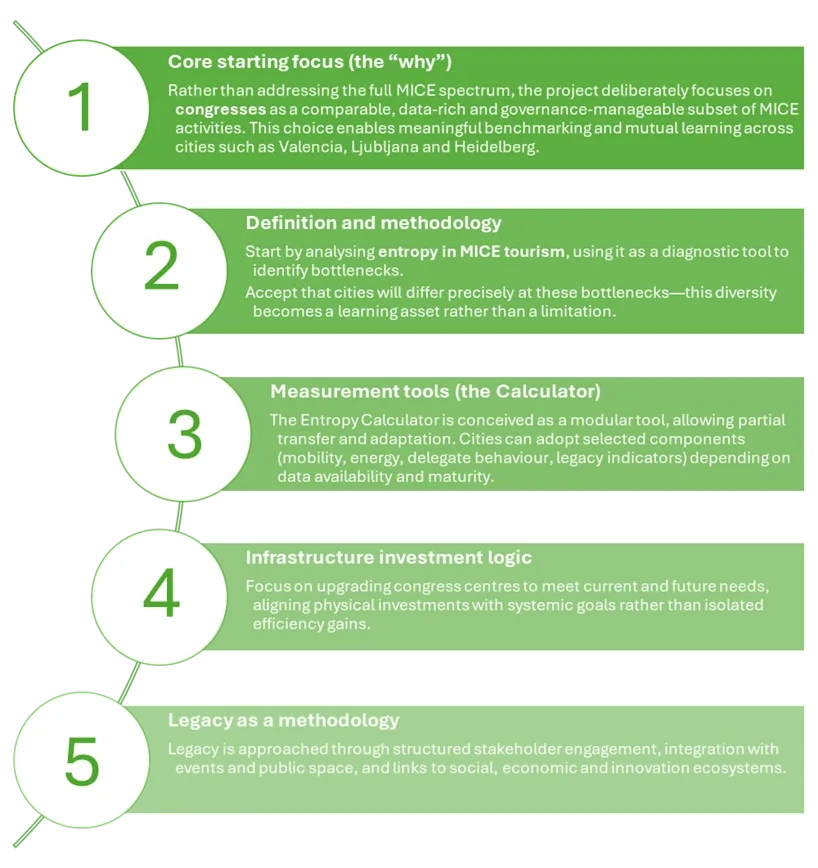
The next chapters of Zentropy MICE will build on this solid foundation, progressively shifting from definition to demonstration, and from experimentation to consolidation, while continuing to generate knowledge that is both locally grounded and transferable across Europe.
Author:
Ana Contreras Escribano
EUI Innovative Actions Expert
About this resource
The European Urban Initiative is an essential tool of the urban dimension of Cohesion Policy for the 2021-2027 programming period. The initiative established by the European Union supports cities of all sizes, to build their capacity and knowledge, to support innovation and develop transferable and scalable innovative solutions to urban challenges of EU relevance.

Similar content