Space as a catalyst for urban transformation. The First Chapter of Stalowa Wola’s Journey

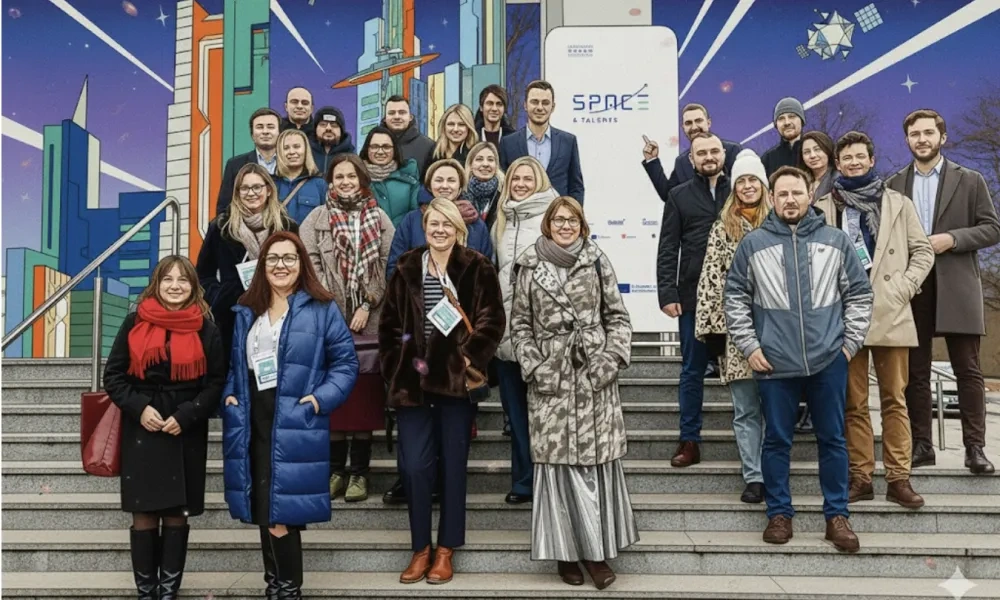
If you are interested in space, this is the right reading for you. But if you are less familiar with satellites and astronauts, and more interested in understanding how cities can attempt to reverse declining trajectories and redefine their future, this is still the right reading for you.
This Urban Diary is not a technical report on space technologies. Rather, it explores the space domain as a catalyst for urban transformation, using the experience of Stalowa Wola—a medium-sized, post-industrial Polish city near the Ukrainian border—as a living laboratory. Through Space4Talents, the city is using the “space lens” to rethink its long-term development model, focusing on talent attraction, STEAM skills and innovation capacity as foundations for a renewed economic value chain and regional positioning.
Funded by the European Urban Initiative, the Space4Talents project does not treat space as an end in itself. Instead, it functions as a strategic policy platform, enabling an integrated approach to urban development that combines education, innovation capacity, competitiveness and identity-building.
This first chapter offers insights from the field. It reflects on the challenges encountered, the solutions tested and the knowledge generated during the first year of implementation.
Space4Talents in a nutshell: strategy and vision beyond space
“From the technological desert we reach the stars”. This is how the StARR Agency, the municipal development agency leading the Space4Talents project, describes the project’s ambition. The phrase hints at both the scale of the aspiration and the depth of the challenge Stalowa Wola is facing.
Image
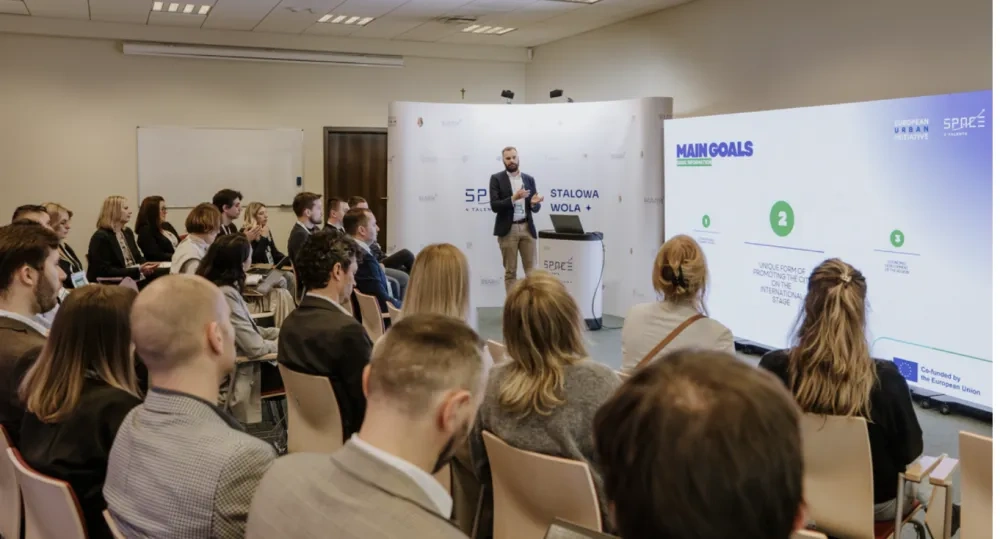
The challenge. The context of transformation
The city of Stalowa Wola—literally “Steel Will”—was founded in the 1930s as a flagship of industrial modernisation. For decades, its identity was closely tied to heavy machinery and defence manufacturing. The post-1989 economic transition, however, led to restructuring, job losses and the gradual erosion of this industrial base. Today, the city faces a challenge common to many European medium-sized cities: demographic contraction and talent outmigration.
Through Space4Talents, the Municipality addresses a fundamental policy question:
How can a city with limited concentration of new technologies reposition itself in a global landscape shaped by innovation and talent mobility?
Image
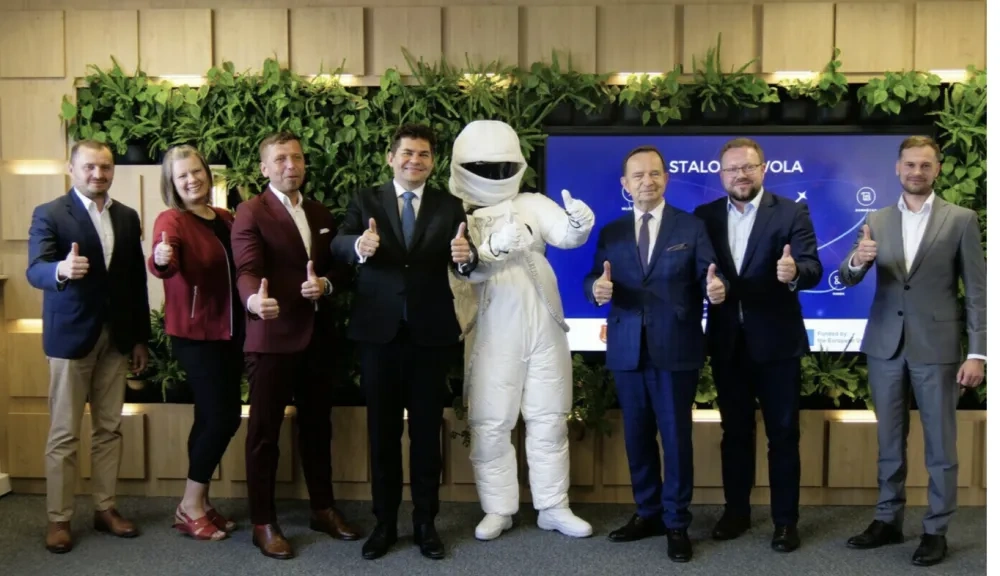
Continuity over rupture
The response builds on the city’s historical DNA. As Mayor Lucjusz Nadbereżny has emphasised, the same “Steel Will” that once powered industrial growth is now being mobilised to secure the city’s future. The strategy moves beyond traditional silos, adopting a cross-sectoral approach that integrates four critical dimensions:
- Skills development by establishing a Space Academy to bridge the gap between traditional engineering and future-oriented STEAM competencies.
- Infrastructure by launching a SpaceLab as a physical and organizational hub for incubation and prototyping.
- Ecosystem Building by utilizing a Penta-Helix approach to foster collaboration between government, academia, industry, civil society, and the youth.
- Urban repositioning with the aim to align local identity with European priorities of strategic autonomy and innovation.
Space as a driver of integrated development
In this framework, the space domain is not a niche technology; it is a connector. It bridges the gap between local needs and European policy priorities, linking symbolic ambition to concrete capacity-building. By doing so, the Space4Talents project places itself at the intersection of urban development, innovation policy, and talent strategy.
Stalowa Wola is not pursuing this transformation alone. Space4Talents is built on a strong, multi-stakeholder partnership covering the full innovation value chain. StARR leads the initiative, ensuring alignment with municipal priorities. Two Universities, Rzeszów University of Technology and Kozminski University, provide scientific expertise and educational frameworks. Innovative Poland Foundation and Rebels Valley LLC help to connect local talent with start-up and investment ecosystems, while INNSPACE Association contributes to bring specialised space-sector knowledge and community-building capacity.
1.1 Why space for cities?
At this point, a legitimate question arises: if the ambition is to revitalise local development through a new, knowledge-intensive specialisation, why choose space?
In the case of Space4Talents, the answer lies in a combination of structural trends, policy dynamics and local conditions. Choosing space as a strategic lever—particularly in a city without an established space industry—may initially appear counterintuitive. Yet, when observed through an urban policy lens, this choice responds to a set of converging dynamics that make space both timely and relevant for cities today.
Beyond the myth: space as everyday urban infrastructure
Space is often associated with astronauts, rockets and frontier missions. But for cities, space is increasingly an invisible infrastructure underpinning everyday life. From satellite-based navigation and communication to weather forecasting, environmental monitoring and disaster management, space-derived data and services shape urban decision-making on a daily basis.
In this sense, space is no longer a niche. It is a practical opportunity for cities to improve public services, strengthen resilience, and experiment with new forms of data-driven governance. As defined by the OECD (1), the space economy encompasses not only the manufacture of satellites and launch systems, but also the wide range of space-enabled applications and knowledge that generate value on Earth.
Space4Talents builds precisely on this interpretation: it is about cities recognising and leveraging this potential for their own needs and growth
Image
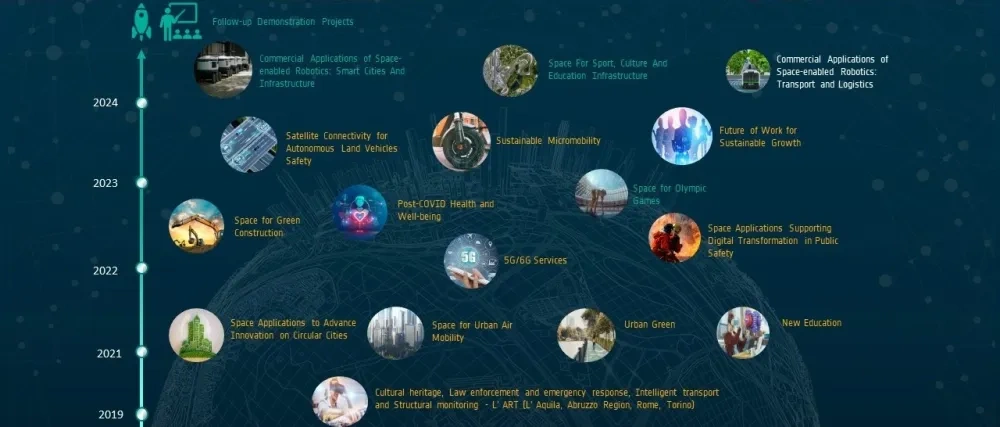
Credits: ESA https://business.esa.int/smart-and-green-cities
Insights from the field. How were activities developed during the first year of implementation?
How were activities developed during the first year of implementation?
This ambitious vision translated, during the first year of implementation, into a strong focus on designing the project’s two core pillars: the Space Academy and the SpaceLab. Both were developed through a collaborative penta-helix approach, involving public authorities, academia, businesses, students and wider societal actors.
At the same time, a wide range of events and initiatives were organised. While not the central objective of the first year, these activities played a strategic role in positioning Stalowa Wola at national and European level, building momentum around the project and maintaining engagement among local stakeholders and the project team.
Although the design processes of the Space Academy and the SpaceLab advanced largely in parallel—each facing partially different challenges—they were both preceded by a critical foundational step: field-based research and ecosystem mapping.
The following sections outline this process in more detail, describing how activities were carried out, which phases they went through, and what insights emerged from the field during this first year of implementation. For each component, particular attention is paid to the main challenges encountered and the solutions tested, reflecting the project’s learning-by-doing approach.
Image
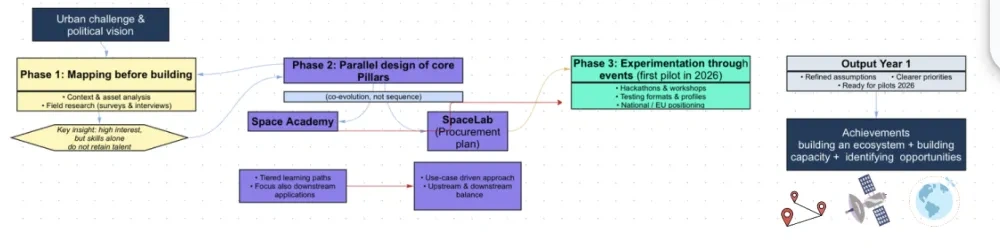
Space4Talents's flowdiagram. Elisa Filippi's own elaboration
Phase 1 – Mapping before building
Early implementation phase
The starting point for both pillars was the effort for understanding the local and regional context. This phase, carried out especially by Kominzky University, combined desk research, fieldwork, surveys and interviews with multiple target groups, including secondary school students, university students, professionals and potential institutional partners.
Main challenge to overcome. The initial challenge was avoiding a “copy–paste” approach. Many space-related initiatives across Europe rely on pre-existing clusters or academic excellence. Stalowa Wola, by contrast, had to work with a fragmented and partially latent ecosystem, where interest existed but was not yet structured.
Solution tested. Instead of defining the Space Academy and SpaceLab upfront, the project chose to adopt an evidence-informed and open-ended design approach. The mapping activities focused not only on existing assets, but also on gaps, expectations and constraints. The aim was to build context-sensitive trajectories for both pillars.
Insight from the field. The exploration phase confirmed that interest in space-related topics was higher than initially expected, but also unevenly distributed across age groups and professional profiles. At the same time, a clear message emerged: while students may be attracted by space as a field of study, training alone is not perceived as a sufficient reason to stay in—or move to—Stalowa Wola. The prospect of specialised, high-quality employment opportunities in the space domain was consistently identified as the decisive factor shaping mobility choices. This reinforced the need for differentiated entry points rather than a single, uniform offer.
Phase 2 – Parallel design of the Space Academy and SpaceLab
Mid-year implementation phase
2.1 The Space Academy: designing skills pathways under uncertainty
Based on the results of the exploration phase, the Space Academy was conceived as a modular and adaptive learning framework.
Main challenge. The first challenge was about thematic specialization and entry level. Space is an exceptionally broad domain, spanning engineering, data, applications and policy. Defining where to position the Space Academy—without diluting its ambition or over-specialising too early—required careful calibration. The second challenge related to the different entry points based on the various target groups.
Solutions tested. To address these challenges, the Space Academy adopted different interconnected design solutions. It introduced a tiered learning structure, offering differentiated entry points tailored to age, background and prior knowledge. Second, the Academy placed a strong emphasis on downstream applications, deliberately anchoring learning activities in tangible urban, environmental and industrial use cases. This will help translate abstract concepts into practical relevance and lower barriers to engagement. Third, the curriculum followed an incremental and feedback-driven design logic. Modules are conceived as adjustable components, allowing content, depth and format to be refined based on participant feedback.
Insights from the field. While the first pilot testing of the SpaceAcademy is expected in early 2026, field observations already confirmed that interest in space-related skills was higher than anticipated, particularly when learning activities are framed around real-world applications rather than abstract technologies. Also, the surveys concluded that skills development must be closely coupled with experimentation, networks and infrastructure if it is to contribute meaningfully to talent retention in medium-sized cities.
2.2. The Space Lab: from infrastructure design to organisational capacity
The development of the SpaceLab followed a progressive and iterative design process, which is still ongoing. The Municipality—through the StARR Agency—approached the SpaceLab as an evolving policy instrument, shaped through continuous interaction between vision, constraints and stakeholder feedback.
An initial phase focused on mapping existing assets, including local infrastructure, facilities and ICT resources, alongside a parallel analysis of potential partners and competitors within the national space ecosystem. This step was essential to identify value chains and avoid duplicating capabilities already available elsewhere.
Main challenges. Three interrelated challenges emerged. Budgetary and spatial constraints limited both the scale and the sequencing of investments, requiring difficult prioritisation choices. Also, the ecosystem maturity posed a risk of over-investing in infrastructure ahead of actual demand. Again, the breadth of the space domain required strategic considerations regarding specialisation, particularly between upstream (hardware and prototyping) and downstream (data and applications) activities, while reflecting on how to capitalise on the city’s defence and industrial legacy.
Solutions tested. In response, the SpaceLab was designed considering the following key principles. A use-case-driven approach, defining what users should be able to do—prototype technology infrastructure on a small scale, analyse satellite data, experiment with applications—and design infrastructure accordingly. Integration is the second principle considered. The Space Lab design adopted a combined upstream–downstream focus, including prototyping capabilities (e.g. small satellites, robotics, drones) with data- and software-oriented activities such as Earth Observation and AI-enabled urban applications.
Insights from the field. Field observations confirm that the SpaceLab is not only an infrastructure project, but also an organisational and governance stress test for the City. Its success depends not on technical specifications alone, but on programming capacity and the ability to connect education, experimentation and market access.
The SpaceLab, and other ancillary training activities planned, also reflect a deliberate local choice: building on Stalowa Wola’s defence and heavy-industry heritage to explore dual-use innovation pathways, rather than treating that legacy as a constraint.
Phase 3 – Experimentation through events and pilot initiatives
Throughout the first year
Although the first pilot testing of the Space Academy and the SpaceLab is planned for 2026, the project used its first year to run a wide range of events, challenges and pilot initiatives, including hackathons, workshops and public talks. These activities were conceived primarily as experimental tools, allowing the city to test formats, gauge interest and observe participation patterns on the ground.
At the same time, they played a complementary role in raising national and international visibility for Stalowa Wola, helping to position the city within emerging space-related networks while generating early momentum among local stakeholders. While events proved effective in positioning the city and motivating stakeholders, they also revealed the limits of one-off initiatives. This insight reinforced the importance of consolidating learning, infrastructure and governance into stable mechanisms.
Image
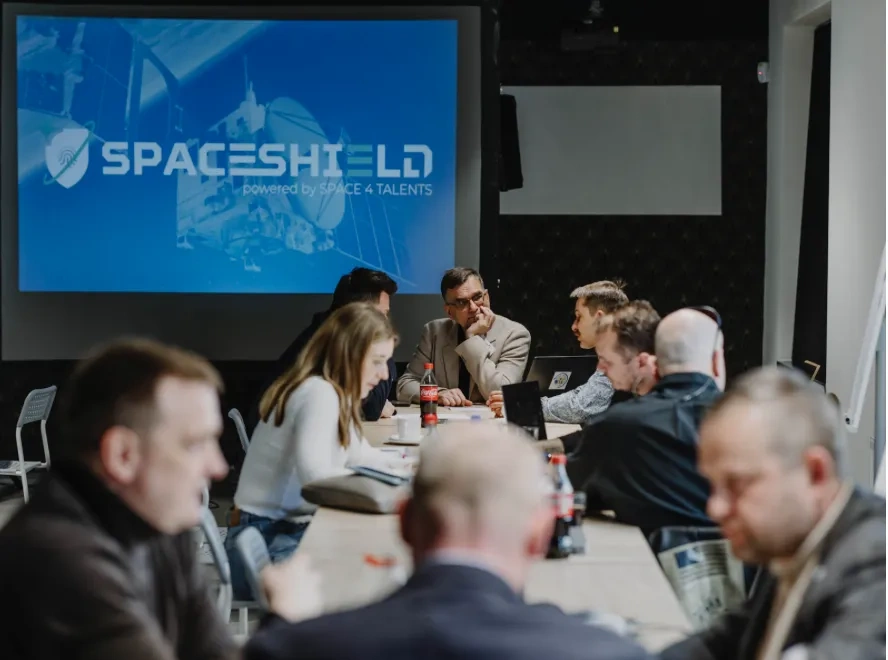
SpaceShield
A shared lesson: co-evolution rather than sequencing
Although the Space Academy and the SpaceLab followed distinct development paths, the first year of implementation made clear that they cannot be treated as sequential or independent components. Skills development, experimentation and infrastructure must co-evolve, each informing the other. Designing one pillar in isolation risks producing either underused facilities or skills disconnected from practice.
This insight reinforces the core learning-by-doing approach of Space4Talents: urban innovation in complex domains requires clear vision and strategic choices, adaptive governance, and the willingness to refine direction as evidence emerges.
3. Lessons learned for other policy-makers
The first year of Space4Talents offers at least three transferable lessons for cities considering space—or other complex innovation domains—as levers for urban development.
1. Build capacity before building technology
Cities don't enter the space economy by building technology, they enter it by building capacity and connecting vision, governance and relational capacities to build technology. Strategic vision must be translated into institutions, skills, coordination mechanisms and partnerships that can sustain implementation over time. Technology follows capacity—not the other way around.
2. Exercise political leadership through clear strategic choices
Ambitious innovation strategies require strong political leadership and the ability to choose. Cities cannot pursue every possible technological direction at once. Clear prioritisation—deciding what to focus on, what to sequence and what to postpone—is essential to avoid fragmentation and to maintain credibility and pragmatism with stakeholders and partners.
3. Treat skills, infrastructure and markets as co-evolving systems
Skills development, physical infrastructure and business creation must be conceived as interdependent pillars and synchronised processes. Training talent without creating opportunities risks outmigration; investing in infrastructure without users leads to underutilisation. Cities must therefore actively create or enable market conditions, ensuring that learning pathways, experimentation spaces and economic opportunities grow together. Otherwise innovation risks becoming a “cathedral in the desert”.
Conclusions
Education is often described as a learning-by-doing process. The first year of Space4Talents shows that the same applies to urban innovation.
Despite the high level of complexity and the multiple uncertainties encountered along the way, the first year of implementation has proven to be a valuable learning phase for the City of Stalowa Wola. It has helped clarify the city’s potential, strategic choices—both those already made and those still to come—and build a more realistic understanding of what it means to engage with a complex domain such as space.
At the same time, this first year has been a collective learning experience. Through experimentation, dialogue and iteration, Space4Talents has begun to reveal the possible connections between two worlds that are often perceived as distant: space and cities.
A new door is open for Stalowa Wola and the other EU cities: a shared learning space for cities willing to test, adapt and progressively build their own space-informed development strategies.
1).OECD (2022), OECD Handbook on Measuring the Space Economy, 2nd Edition, OECD Publishing, Paris, https://doi.org/10.1787/8bfef437-en.
About this resource
The European Urban Initiative is an essential tool of the urban dimension of Cohesion Policy for the 2021-2027 programming period. The initiative established by the European Union supports cities of all sizes, to build their capacity and knowledge, to support innovation and develop transferable and scalable innovative solutions to urban challenges of EU relevance.

Similar content