Reviving guild traditions: How Bistrița is inspiring a new generation through Eco-Guilds


Bistrița is turning to its past to inspire a more sustainable future. Once a powerful medieval trading centre where craft guilds shaped both the economy and the city’s defences, Bistrița is now drawing on this legacy to engage a new generation. Through B-CONNECT, the Romanian city is reimagining guilds for the 21st century, this time focused on ecology, technology, and creativity. Mobile Creative Hubs, designed as modern ’Eco-Guilds’ will travel between schools to spark curiosity and build practical skills.
In the 15th century, Bistrița was the most powerful citadel in Transylvania and a major centre for crafts. In those times the people of Bistrița organised themselves into several craft or commercial associations, called guilds. Due to constant threats, the citizens built a stone fortress with 18 towers and bastions, which were maintained by 20 different craft guilds. The most famous guilds in the city were those of butchers, silversmiths, furriers, tailors, blacksmiths, coopers, ropemakers and saddlers. The guilds' trade privileges came with the duty of defending the city, where they were responsible for guarding the towers. Over time, most of the original defensive structures were lost, and out of the 18 towers only the Coopers' Tower stands now.
Medieval guilds were responsible for transmitting craftsmanship and specialised knowledge to the younger generation through practical training in a tightly structured apprenticeship system. Young apprentices lived with a master craftsperson and learned primarily by observation, imitation, and hands-on practice. Masters demonstrated each stage of the craft, supervised the apprentice’s work, and corrected mistakes directly. Skills were passed down gradually, beginning with simple tasks and progressing to more complex techniques. After mastering the basics, an apprentice became a journeyman, travelling to gain broader experience and working for pay but without the right to run a shop. To become a master, a journeyman had to create a high-quality “masterpiece,” pay the required fees, and prove their competence to the guild.
Image
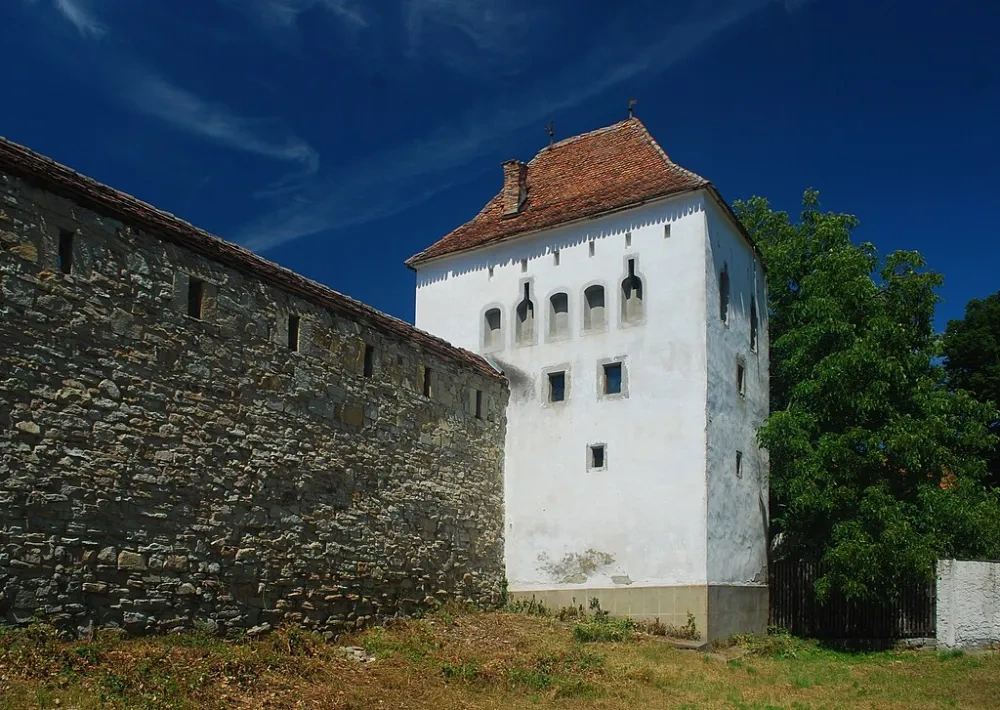
Coopers’ Tower, the last remaining guild tower in Bistrița (image: Wikimedia Commons)
The B-CONNECT project builds on an innovative approach that combines biophilic-centred tactical urbanism, digital frameworks, and community engagement. Inspired by the history of Bistrița and the important role medieval guilds played in the city, the project introduces a new generation of ‘Eco-Guilds’ designed to give youth a hands-on role in shaping a greener and more innovative urban environment. Operating as Mobile Creative Hubs, these Eco-Guilds aim to spark local talent and build practical skills in sustainability, technology, and creative placemaking.
B-CONNECT is centred on temporary, citizen-led, small-scale greening interventions that are supported by a range of digital tools, which enable assessment of the impact of tactical urbanism interventions, and promote more environmentally conscious behaviour. To cover key thematic areas of the project, three Mobile Creative Hubs will be launched in Bistrița under the Eco-Guild banner, one focused on nature and the environment, another on robotics and eco-technology, and a third on art and placemaking. These hubs will introduce young people and children to each field through hands-on, creative learning experiences. Designed as compact mobile platforms, the hubs can be easily moved between various educational institutions, reflecting the flexible, tactical urbanism principles at the heart of B-CONNECT.
Ana Dragomir, an urban planner at Urbasofia, a town and regional planning company involved in B-CONNECT, provided some details about the origin of the Eco-Guilds scheme: “The idea of Eco-Guilds emerged from a historical analysis of the city and the significant role medieval guilds played in its life. Reviving this tradition inspired us to develop a new generation of hybrid, future-oriented guilds for the 21st century - Robotics and IT, Nature and Environment, and Art and Placemaking. Each guild covers a specific field, but works in an interdisciplinary way, and in direct connection with the city and its transformation. Their role is to reconnect people with knowledge, craftsmanship, and community purpose - things the city has gradually lost.”
A comprehensive design plan has been developed for Bistrița’s Mobile Creative Hubs, outlining their architectural layout, functional features, and technological setup. Each of the three hubs will start from a standard mobile platform, which will then be adapted to reflect the specific needs of its Eco-Guild theme. Resembling food vans without kitchens, these mobile units will be fitted with customised equipment.
For each Eco-Guild, a dedicated professional team has been formed to develop the educational framework, define the training modules, and design the hands-on activities, along with the equipment needed to support them. Teachers from the host schools will also play an active role, contributing to both the development of activities and the planning of equipment for the Eco-Guilds.
The Eco-Guilds will operate within educational institutions, spending set periods in each location. While the initial plan was to pilot the three hubs in just four schools, the project partners chose to broaden the scheme by opening a call for interest to all schools in Bistrița. By the end of September, seven schools and three kindergartens had been selected to host the hubs during the project’s lifetime. The Creative Hubs will remain longer in schoolyards, while kindergartens will host them for shorter, mostly week-long visits. Beyond the education network, the hubs will also appear at festivals and major public events to showcase B-CONNECT. A detailed activity calendar will map out when each hub is stationed at each institution.
Image
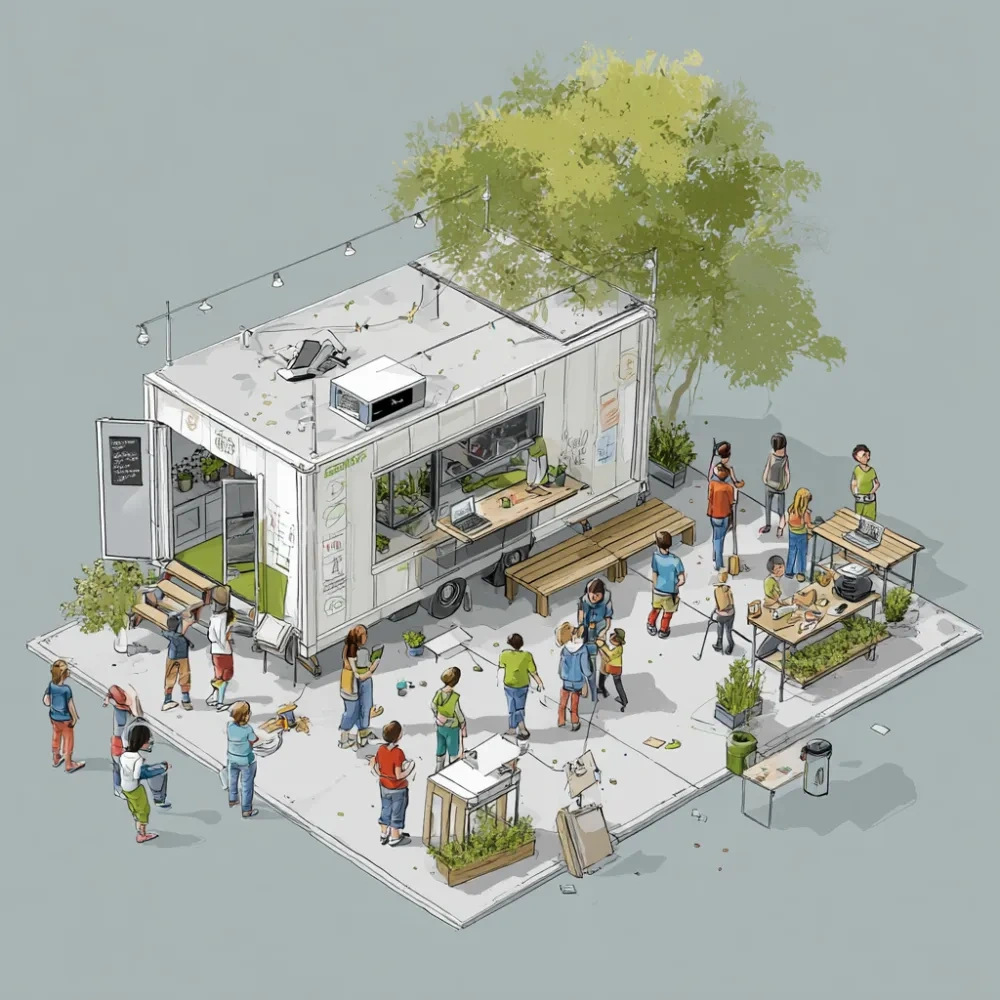
Visualisation of an operating Eco-Guild (visual: Ana Dragomir)
Highlighting the importance of Mobile Creative Hubs in Bistrița, Codruț Papina, an urban planner and landscape designer at Urbasofia explained the following: “Mobile Creative Hubs are crucial for Bistrița because they respond to one of the city’s biggest challenges: young people are leaving. With limited university pathways - local extensions of the Babeș-Bolyai University and the Technical University of Cluj have low activity - many young residents feel they must go elsewhere to grow. The hubs aim to counter this by nurturing talent, offering opportunities to learn new skills, and creating experiences deeply connected to the city and its people. Through B-CONNECT, they become catalysts for youth engagement, creativity, and empowerment. Ultimately, we want young people to feel ownership of their city and to see that they can build a meaningful life in Bistrița.”
The Eco-Guild dedicated to Nature and Environment led by the University of Agricultural Sciences and Veterinary Medicine of Cluj-Napoca in collaboration with Babes-Bolyai University, will immerse young people and interested residents in the science behind urban ecosystems. Through hands-on work with hydroponic towers, mobile air-quality sensors, and microclimate monitoring kits, participants will explore how hydroponic towers work, how they can be used, and how they should be maintained, how changes in microclimate influence the development of urban greenery, and how built environment affects urban microclimate and air quality. Equipped with tools ranging from a mini greenhouse to pocket microscopes, the hub turns environmental learning into an interactive, city-focused laboratory.
The Robotics and IT Eco-Guild coordinated by E-Civis Association - a civil society organisation focusing on digital education - and Indeco Soft, a provider of eGovernment and eAdministration solutions, will offer students the chance to dive into programming, engineering, and urban sensing technologies. With robotics kits and an infrastructure for urban sensory networks, participants will test navigation algorithms and calibrate sensors for different conditions.
In the Art and Placemaking Eco-Guild led by Ion Mincu University of Architecture and Urbanism together with Urbasofia, students will strengthen skills in creative writing, artistic illustration, and spatial thinking while experimenting with tools such as a 3D printer, laser engraver, and craft materials. Within the creative hub workshops are planned to be held on making urban furniture, on architecture, urbanism natural and anthropogenic landscapes, and on augmented and virtual reality visualisation.
The platforms and equipment for the three Creative Hubs are expected to be procured by April 2026, with the Eco-Guilds set to become operational in the autumn of the same year. After the project concludes, the municipality of Bistrița will retain ownership of the mobile hubs, while partner schools will continue to run them as part of their educational programmes. In the longer term, the city plans to expand the network of participating institutions, ensuring that more students can benefit from the initiative.
As Bistrița prepares to launch its Mobile Creative Hubs, the city is investing not only in new equipment but in a long-term vision of youth empowerment and urban resilience. By blending historical inspiration with forward-looking educational tools, the Eco-Guilds aim to cultivate skills that matter for the future—sustainability, innovation, and creative city-making. After the project ends, the municipality and partner schools will continue operating the hubs, ensuring their impact endures.
About this resource
The European Urban Initiative is an essential tool of the urban dimension of Cohesion Policy for the 2021-2027 programming period. The initiative established by the European Union supports cities of all sizes, to build their capacity and knowledge, to support innovation and develop transferable and scalable innovative solutions to urban challenges of EU relevance.

Similar content