A multi-voice conversation on building urban resilience against floods and droughts

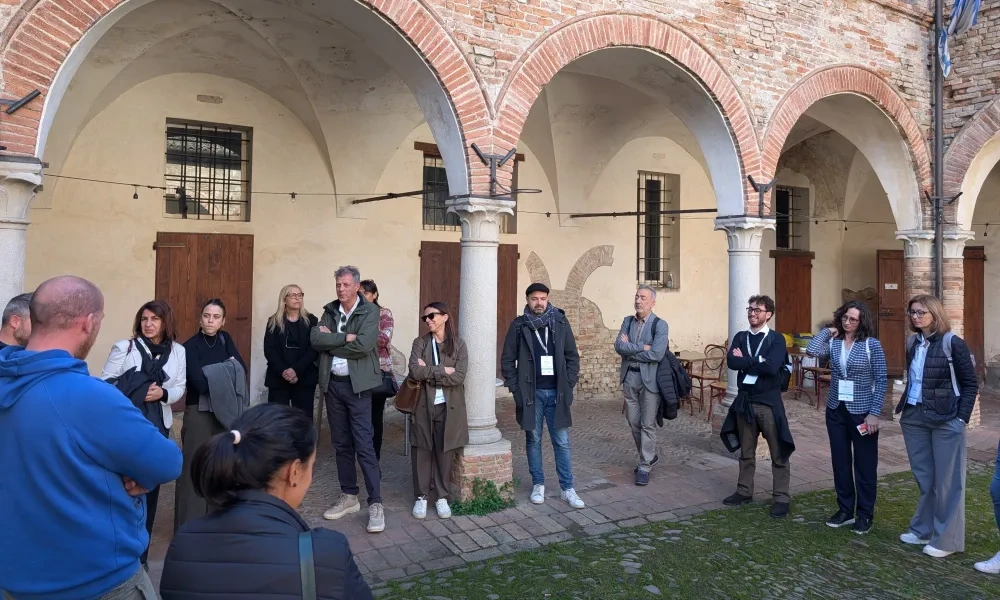
Faenza, 28 October 2025 – A public conversation on the EUI–Innovative Action AQUAGREEN project (Acquiring Urban Resilience Against Floods and Droughts), bringing together institutional voices, technical experts and project partners to reflect on the first year of work, the innovations under development, and the challenges of adapting cities to a changing climate.
Setting the scene: climate impacts and the need for cooperation
Andrea Fabbri, Deputy Mayor of the Municipality of Faenza
Faenza has been strongly affected by climate-related events. The floods of May 2023 had a devastating impact on the city and on the AQUAGREEN pilot area. In just two years, the same areas were flooded three times, with water levels reaching six to seven metres. Much has been done since then, but the challenge remains big. We have to shape our city for a new climate, which is still changing in unpredictable ways. We need to change our way of thinking, and this is why we are engaging with technical partners, the European Urban Initiative and our transfer cities Verviers (Belgium), Michalovce (Slovakia) and Slavonski Brod (Croatia): we need cooperation, knowledge and experiences to make our city more resilient and innovative.
Luca Ortolani, Councillor for the Environment of the Municipality of Faenza
Climate change is no longer an abstract concept: its effects are already here, regardless of denial. Climate and weather are not the same, and a significant effort is needed to help people understand what is happening. A significant effort is needed globally to help people understand what is happening with climate and weather, but at the local level awareness must go hand in hand with preparedness. Droughts, for example, have long been a concern in this territory, and therefore, we are well prepared. For decades, work has focused on water scarcity, with the creation of basins and artificial lakes to support urban and agricultural water use.
On the other hand, water no longer retained in soils accumulates in the atmosphere, leading to extreme rainfall events as the one in May 2023, during which Faenza experienced the equivalent of a year’s precipitation in just two weeks. Traditional concepts such as return periods are no longer applicable, as change has moved beyond scale: the May event corresponded to a millennial return period, and in 2023 alone there were 16 red alerts, followed by four in 2024. The impacts were not limited to flooding. At the territorial scale, the emergency involved entire river systems, enormous quantities of debris and mud, and the need for large spaces to manage these materials, including 2.5 hectares filled with up to seven metres of waste, plus an even larger volume of mud.
Faenza is constantly moving between emergency response, reconstruction, and a fundamental question: how can impacts be anticipated and preparedness strengthened? Capacity building is key, as is learning how to build and retrofit differently in a city where most of the built environment already exists. Interventions must therefore take place between buildings, through targeted projects and retrofitting strategies.
Preparedness also means empowering citizens with knowledge about what they can do to protect themselves and informing them through early warning systems, which are essential to preparedness, as they can save time and lives. And it requires also a profound knowledge of the territory, to understand how the networks are responding in order to intervene quickly and effectively, and acting throughout the entire city, as during emergencies also ordinary activities are altered.
The guiding principle is clear: water will come. The challenge is to allow it to enter and leave without causing damage during abundance, and how to treat it as a resource to be retained and reused during dry periods, rather than being drained away as quickly as possible. We know that infrastructure remains fundamental to this effort, but it is not sufficient on its own. Integrated, systemic and distributed approaches must complement them as AQUAGREEN is doing.
A conversation on AQUAGREEN solutions, systems and processes
Moderator: Vittore Negretto, IA Expert
The institutional perspectives highlighted the scale of climate change impacts in Faenza and the need to intervene not only where flooding has already occurred, but across the entire city and its wider territory. Managing water everywhere, and not just in hotspots, is one of the core challenges addressed by AQUAGREEN.
The project responds to this challenge by working across scales, sectors and forms of knowledge. In the following sections, three voices from the project reflect on different but interconnected dimensions of innovation: physical and technical solutions, digital and data-driven systems, and social and governance processes
Physical and technical innovation: nature-based and infrastructural solutions
AQUAGREEN places strong emphasis on infrastructures and systems that directly mitigate flood and drought risks, enhancing urban resilience through tangible spatial interventions. One of the project’s central elements is to integrate green and blue solutions to manage water in an integrated way, closer to where it falls. These activities are coordinated by Romagna Faentina Union, led by Patrizia Barchi, Head of Public Works Department and P.M. for AQUAGREEN, a department represented today by Ilenia Bertozzi, as well as the University of Bologna team, led by Full Professor Patrizia Tassinari, represented today by Professor Alberto Barbaresi. Dear Ilenia, dear Alberto, what expertise and partnership does it take to design spatial solutions that physically change how the city prepares for and manages climate risks?
Ilenia: Designing urban drainage solutions integrated into the Multifunctional Resilience Park requires a genuinely collaborative environment. This project goes far beyond a conventional intervention such as a road or a car park. It involves buildings, open spaces and complex Sustainable Urban Draninage Systems (SUDS), all working together. In approaching and defining this project, the University of Bologna's contribution has been fundamental. Only through detailed hydraulic modelling and calculations is it possible to understand, for example, how much water flows through a pipe, or how large a rain garden needs to be to achieve specific performance targets. This is not simply about reshaping the land to make a project look attractive, but about shaping a functional and integrated water management system. And in the decision-making and design process, calculations and models have taken on increasing added value.
Alberto: Three departments of the University of Bologna are involved in AQUAGREEN: Architecture, Civil Chemical Environmental and Materials Engineering, and Agricultural and Food Sciences. This intra-university collaboration is essential for integrating different types of knowledge that deals with urban planning, drawing, history and conservation, hydraulics, survey, roads, ornamental crops, and agricultural and biosystem engineering. The university’s contribution lies in the smart integration of engineering solutions and nature-based solutions designed to reduce pluvial flood risk while also addressing periods of drought. By combining these approaches within a single, coherent framework, the project aims to enhance overall effectiveness, achieving outcomes that exceed what each solution could deliver if implemented in isolation. In parallel, participatory activities – including citizen engagement supported by virtual reality tools, historical and conservation analyses – provide an additional layer of value, strengthening the project’s impact and fostering a shared understanding of climate adaptation strategies. For the university, this project represents an ideal testbed to finally integrate different kinds of the abovementioned solutions and their connection. Equally important is the integration of academic knowledge with the municipality's operational knowledge. These worlds have different goals and checklists, and their interaction creates added value, including in the way citizens are engaged.
Vittore: As a pilot, AQUAGREEN is also generating data and experience that can inform future interventions. How can what is being learned feed into wider policies and practices within the Romagna Faentina Union?
Ilenia: This is very much a pilot project. During the modelling for the new car park drainage systems, for example, thanks to the hydraulic analyses of the site run by the University of Bologna, we realised how much water can actually be stored using this type of technology. Once we have completed construction and gathered operational data, these solutions can be replicated whenever similar interventions are planned elsewhere. The same applies to rain gardens and other nature-based solutions. Of course, local conditions such as soil characteristics matter, but the replication potential is high. This project allows the municipality to test solutions that can later become part of standard practice.
Vittore: Based on this experience, what advice would you give to other cities interested in starting a similar process?
Ilenia: Partnerships are playing an essential role in our process, and trust within those partnerships is just as important. At the beginning, the process was new and we had to understand what to keep and what to let go. External experts had a deep understanding of how hydraulic solutions work on the technical side, and we, as a Municipality, wanted to be sure that this would be integrated with valuable local knowledge. This tension was explored while drafting different options and solutions, in a shared effort to build mutual understanding, as all the partners believe that creating spaces where all forms of knowledge and perspectives can be heard is crucial for making such complex projects work.
Image
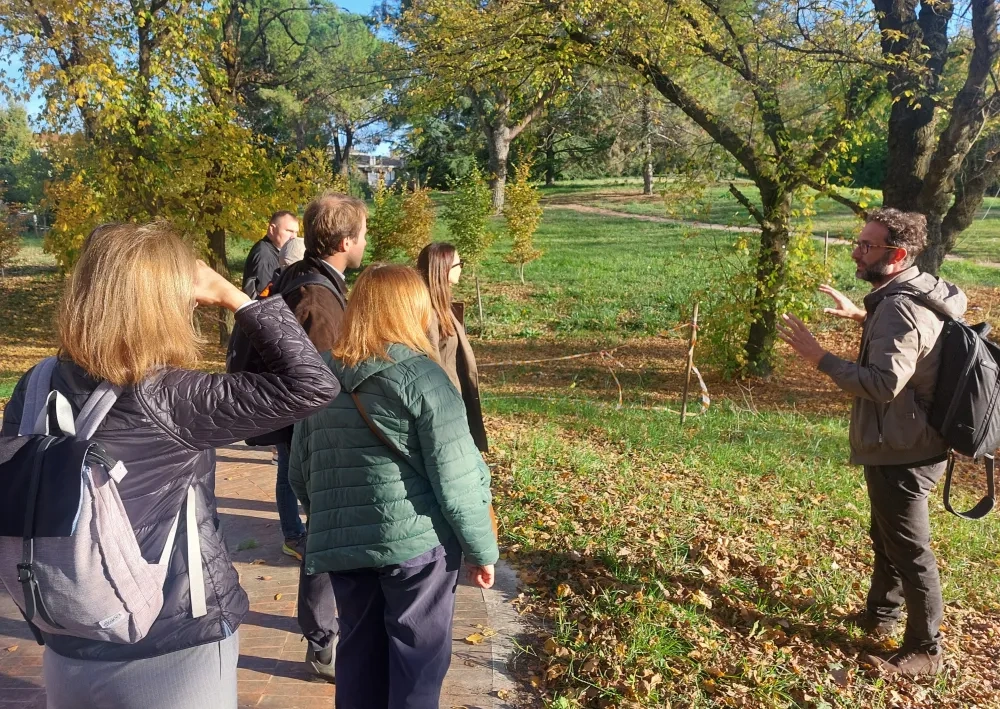
Prof. Barbaresi describing the current hydraulic conditions during a site visit in Parco Gatti in Faenza, site of the future Multi Resilience Park. (Copyright Marco Affronte)
Digital and data-driven innovation: tools for preparedness and decision-making
Vittore: Beyond physical interventions, AQUAGREEN relies on data and digital systems to support preparedness, management and communication led by the team of Iuav University of Venice, represented today by Daniele Pagliari, Research Fellow. Dear Daniele, which activities and partners are contributing to building knowledge for the two key tools are under development: the Early Warning System and the spatial Decision Support System?
Daniele: Both systems are built on data. In the early stages of the project, a significant effort has focused on gathering and organising information. One of the main challenges is dealing with data from very different sources and of different types, without combining them in ways that could undermine their reliability. Data needs to be structured both thematically and spatially, and clearly distinguished between quantitative and qualitative information. Iuav University of Venice coordinates this process and, while the entire consortium contributes to this effort, two technical partners play a particularly crucial role.
HERA, a major multi-utility company active in water and energy services, contributes in-depth knowledge of the hydraulic characteristics of the territory, including networks, basins, and the conditions under which the system’s capacity could be exceeded.
CAE, a private company specialised in multi-hazard monitoring and early warning systems, brings expertise in monitoring technologies, including sensor selection, placement, and data flow management.
The Municipality of Faenza’s IT services are also key, as they manage a wide range of spatial datasets related to the territory. Finally, the civil protection sector provides essential operational knowledge, offering insights into what works during emergencies, what does not, and where the main challenges lie.
Vittore: What is the main objective behind these tools, and how are they expected to be used in practice?
Daniele: The primary objective is to inform action. During emergencies, the Early Warning System will support civil protection by providing real-time data from a network of sensors and enabling better, faster, and more informed decision-making. Over the longer term, the Decision Support System will help guide everyday water management decisions, highlighting different options and their potential benefits, and inform urban decisions towards a systemic implementation of water policies. Both these tools enable a multi-scale approach, linking local conditions with the broader territorial context and offering a more comprehensive view of risk and resilience.
Image

Historical banner of Borgo Durbecco - the quarter where the Multi Resilience Park will be implemented. (Copyright Vittore Negretto)
About this resource
The European Urban Initiative is an essential tool of the urban dimension of Cohesion Policy for the 2021-2027 programming period. The initiative established by the European Union supports cities of all sizes, to build their capacity and knowledge, to support innovation and develop transferable and scalable innovative solutions to urban challenges of EU relevance.

Similar content


Social and governance innovation: participation and co-design