If we were to give Nature a voice: listening to La Goccia


What would nature tell us if we could truly hear it? GOCCIA explores this question through the silent, resilient voice of La Goccia’s spontaneous forest - a place where life has been reorganising itself for decades. This article invites readers to look, listen and rethink how cities learn from the natural intelligence that surrounds them.
Setting the scene: why listen to nature?
When I first started working as an Innovative Actions Expert for the European Urban Initiative, I scanned the list of approved projects in the second call with curiosity. Among the twenty-two selected proposals, one immediately stood out. Its description was unlike anything I had seen in an urban development project: an Interspecies Playground, interspecies design thinking, spontaneous phytoremediation, a quintuple-helix governance model including the environment as a stakeholder. These were not the typical terms of municipal regeneration plans or brownfield remediation strategies. They spoke to a deeper ambition: to rethink not only how we repair polluted soils or create new green areas, but how we understand the relationship between humans and nature within the contemporary city.
My first contact with the GOCCIA project in Milan was therefore not neutral. It resonated as something unusual, bold, and almost philosophical. When I was later invited to interview for the position of IA Expert, I carried only that published 218-word description with me. And yet, the interview made its intentions even clearer. After a series of structured questions, each city had the chance to ask something specific. I will never forget Vera’s (the municipal officer in charge for the application) final question:
“If you had to integrate nature as an actor in a governance model, how would you do it?”
It was a disarming question. I have experience designing governance models for urban policies, multi-stakeholder processes, and biodiversity initiatives, but I had never been asked to imagine a form of governance where a plant, a bird or a microorganism could be considered a stakeholder. Our governance tools rely heavily on language - written texts, deliberation, negotiation. Animals have mouths but do not speak, and plants do not even have mouths. So how, exactly, could they participate?
The question stayed with me, and it has become one of the guiding reflections behind this article: if we were to give nature a voice, what would it tell us - and how can a project like GOCCIA help us listen?

Biodiversity is a form of communication: every species signals the health, balance and direction of an ecosystem.
Listening to nature when it cannot speak
The first step is acknowledging a simple truth: nature does not speak in human languages, but it does communicate in multiple ways. Scientists decipher those signals through ecological indicators, biodiversity monitoring and long-term observation. Urban planners and policy makers, however, are often detached from that scientific language. Governance frameworks tend to focus on stakeholders who can sit at a table, express their positions, negotiate and agree on actions. This means that nature is usually represented indirectly - through environmental agencies, researchers or NGOs - and rarely recognised as an active agent whose needs, rhythms or behaviours should influence the direction of urban development.
Yet cities increasingly depend on ecological intelligence. As climate change accelerates, as soils degrade, as temperatures rise and species decline, the question is no longer whether nature should have a voice, but whether cities can afford not to listen.
This is where science becomes a translator between ecological processes and urban decision-making. Indicators such as the presence of lichens on bark, the diversity of macroinvertebrates in a riverbed or the abundance of breeding birds in a district reveal more than we expect. They communicate the state of air quality, pollution levels, ecosystem maturity, and the resilience of the environment to disturbances. Biodiversity is not only a measure of life; it is also a measure of environmental health, of the ability of a place to regenerate itself.
This framing allows governance to evolve. Rather than imagining literal participation of animals or plants, we can begin to incorporate their “voices” through data, ecological assessment, monitoring and scientific interpretation. This form of interspecies governance may seem indirect, but it is more than symbolism. It is about designing urban strategies that are informed by the needs and capacities of the natural systems we inhabit.
What nature tells us through biodiversity
In ecological terms, biodiversity communicates consistently and honestly. A site with low diversity often signals environmental stress or degradation. A site with high diversity indicates environmental quality and ecosystem maturity. But biodiversity also communicates directionality: it tells us where the ecosystem is going. An increase in complexity often points to natural regeneration; a decrease may signal disturbance or imbalance.
In cities, these indicators challenge our traditional perceptions of nature. Many urban residents have grown used to manicured parks, uniform lawns and pruned hedges. These landscapes offer visual order but little ecological functionality. Their diversity is low; their capacity to host insects, birds, fungi or microorganisms is limited; and their contribution to climate resilience is marginal.
The ecosystems that offer the greatest benefits often look “messy” to the urban eye. They include dead wood, spontaneous vegetation, uneven canopies, and understories made up of species we classify as weeds. And yet, these are the ecosystems that cool urban districts, improve air quality, regulate humidity, capture pollutants, foster biodiversity by creating habitats for dozens of species.
When biodiversity is thriving, nature is effectively saying: “Conditions are favourable. Life can flourish here.”
And when biodiversity declines, it warns us: “Something is wrong. Pay attention.”
Understanding these messages is essential for forward-looking urban governance.
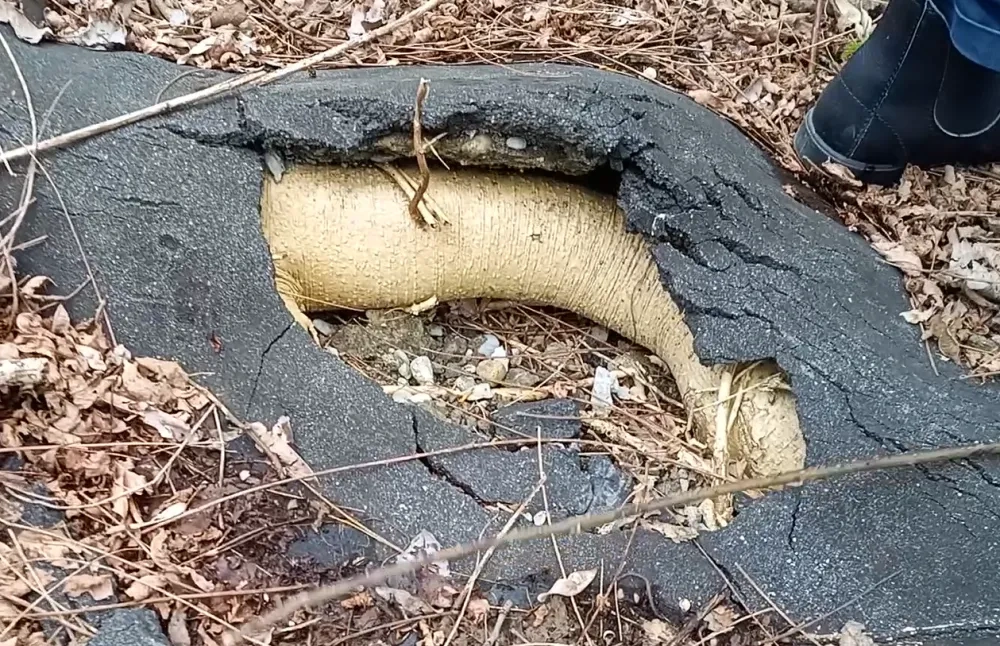
At La Goccia, nature has been reorganising itself for decades - breaking asphalt, creating niches, and slowly healing the soil.
What La Goccia is already telling us
La Goccia - once a gas production site contaminated with heavy metals and hydrocarbons - has spent the last thirty years without human intervention. What emerged in this timeframe is remarkable: a spontaneous forest in the dense urbanisation of Milan. The existence of this woodland is itself a message, perhaps the most important one the place can offer:
If humans step aside, nature will reorganise, adapt and begin to heal - even in difficult, polluted conditions.
This is not romanticism. It is ecology. Soil microorganisms, opportunistic pioneer plants, fungi and bacteria have been working quietly, slowly breaking asphalt, degrading contaminants, stabilising soils and creating niches that allow other species to follow. The process is imperfect and uneven; some pollutants persist. But the trend is clear: the system is moving towards complexity, not collapse.
This spontaneous phytoremediation is the starting point of the GOCCIA project. Instead of imposing a technical solution from scratch, the project begins by listening to what the site has already done on its own. This represents a radical shift in perspective for urban regeneration:
- The site is not an empty canvas waiting for human design.
- It is a living system that has been self-organising for decades.
- It holds ecological knowledge about what works, what adapts, and what thrives in this specific environment.
GOCCIA’s scientific activities - analysing plant–microorganism interactions, monitoring biodiversity, and studying contaminant degradation - are ways of listening to this ecological intelligence. In this sense, La Goccia (the area where the GOCCIA project is located) is not only a place to be reclaimed; it is a teacher.
What it tells us is powerful: Nature can be an active agent in urban remediation, if we respect its logic and learn from its processes.

Urban aesthetics often favour order over ecological function - yet manicured lawns offer far less resilience than diverse, spontaneous ecosystems.
When nature does not match our idea of beauty
One of the challenges of listening to nature in cities is that its expressions do not always align with our cultural expectations of beauty. Urban aesthetics have been shaped by centuries of control: straight lines, trimmed lawns, uniform tree species, predictable colours. Spontaneous ecosystems, however, follow a different aesthetic logic - one based on function, not human preference.
This gap can create resistance. Residents may perceive wild areas as messy, unkempt or unsafe. Urban managers may see them as signs of neglect rather than regeneration. Yet these spontaneous systems often provide more ecosystem services - heat mitigation, biodiversity support, pollution removal, shading and soil enhancement - than manicured parks.
The challenge is therefore cultural as much as ecological. We need to cultivate new forms of appreciation for ecological aesthetics, recognising beauty in diversity, complexity and resilience. Part of GOCCIA’s mission is precisely this: helping Milan to reconnect with the ecological identity of La Goccia, even when it differs from conventional park design.
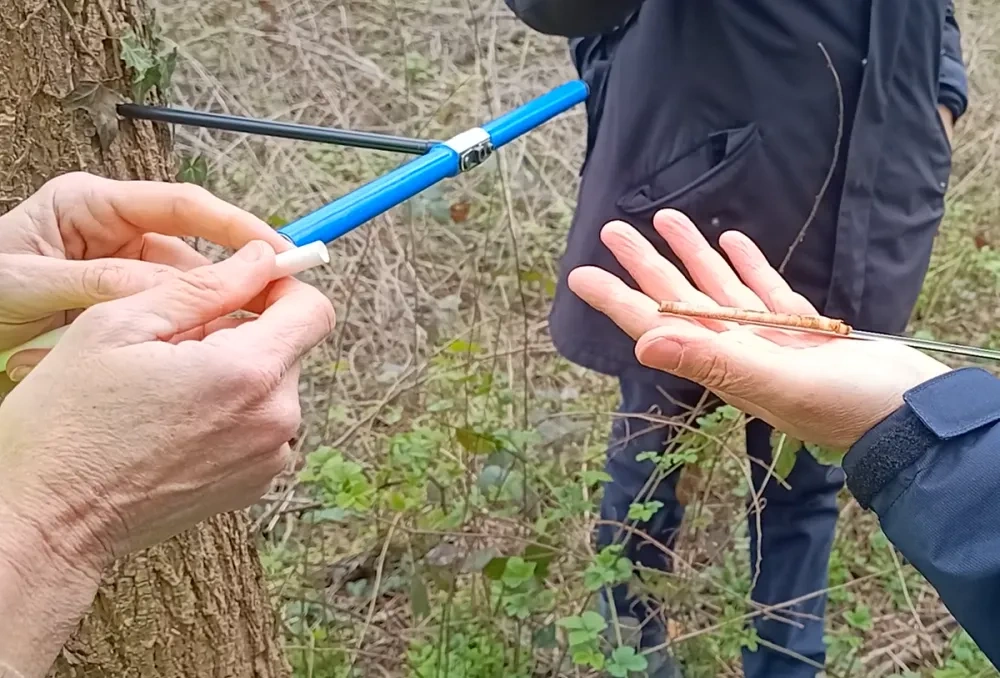
Scientific monitoring at La Goccia helps translate ecological signals into urban knowledge - a practical form of interspecies governance.
Towards interspecies governance
Returning to Vera’s original question - how to integrate nature as an actor in governance - the experience of GOCCIA suggests a path forward.
Interspecies governance does not mean bringing animals or trees into a meeting room. It means:
- Translating ecological data into decisions, so that soil reclamation processes, biodiversity trends and ecosystem dynamics shape policies.
- Respecting ecological timescales, even when they do not match political cycles or construction deadlines.
- Designing interventions that strengthen natural processes instead of replacing them.
- Creating partnerships between scientists, professionals, residents and city officials to interpret nature’s signals collectively.
- Embedding the environment as a recognised stakeholder whose wellbeing is essential to the wellbeing of the city.
In this sense, GOCCIA is an experiment in interspecies collaboration. It combines scientific study, urban planning, design, community engagement and ecological thinking. It challenges Milan to design a governance model where decisions are not only human-centred, but ecosystem-centred.
A gentle echo of Jane Goodall
In reflecting on these ideas, it is impossible not to think of Jane Goodall, whose recent passing marks the end of one of the most profound voices in our understanding of the human–nature relationship. Goodall demonstrated that listening to nature requires patience, humility and attention. She showed that intelligence is not a human monopoly, and that empathy can be a scientific method.
Goodall often reminded us that “change happens by listening and then starting a dialogue with the stakeholders who are doing something you don’t believe is right.” GOCCIA extends this idea further: urban stakeholders now include more than humans. The forest of La Goccia is a stakeholder, too - one that has been “doing something” for decades, quietly regenerating itself.
In this sense, the project is a continuation of Goodall’s legacy: it invites us to observe, to listen and to recognise the agency of other species in shaping shared futures.
Conclusion – what nature would tell us today
If nature had a voice, what would it say? After spending time in La Goccia, I believe the message would be simple but profound:
“I can heal, but I need space. I can regenerate, but not at your speed. I can help your city thrive, if you learn to see me as a partner rather than an obstacle.”
The GOCCIA project offers Milan - and Europe - a rare opportunity: to learn from a spontaneous ecosystem that has been evolving in silence for three decades. To treat nature not as a backdrop, but as a collaborator. And to explore new forms of governance where urban development and ecological intelligence move forward together.
Listening to nature is not a metaphor. It is a practical requirement for the future of cities.
La Goccia already speaks. The real question is whether we will choose to listen.
About this resource
The European Urban Initiative is an essential tool of the urban dimension of Cohesion Policy for the 2021-2027 programming period. The initiative established by the European Union supports cities of all sizes, to build their capacity and knowledge, to support innovation and develop transferable and scalable innovative solutions to urban challenges of EU relevance.

Similar content