Bruges’ path to becoming a water-resilient city: Blue4Green Urban Diary #1

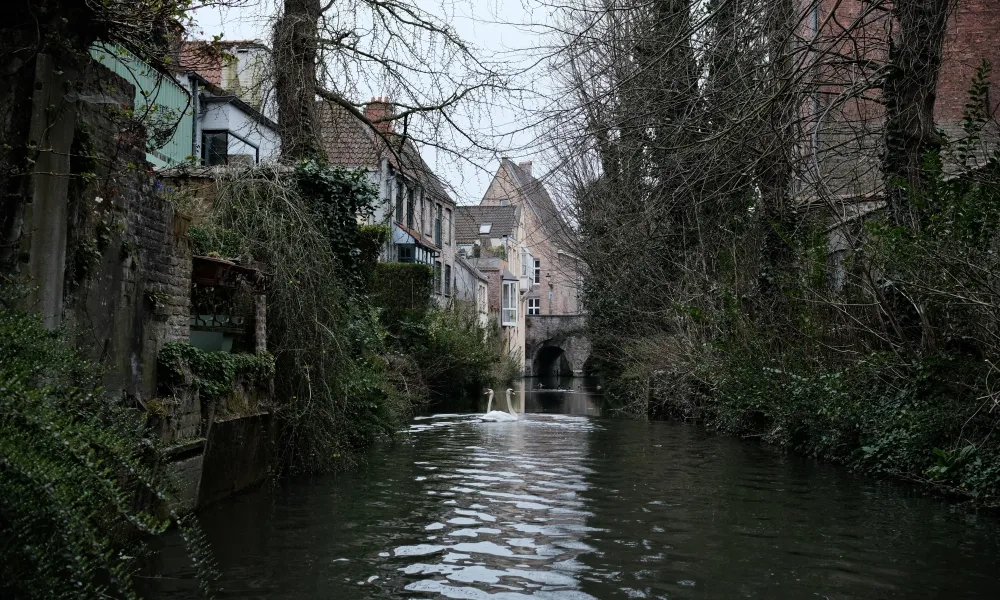
The City of Bruges is rethinking its relationship with water and green spaces in times of the climate crisis. This first Blue4Green Urban Diary follows the city’s journey towards water resilience, from smart sensors and community engagement to governance innovation, showing how local action in a historic city can inspire change across Europe.
Cities across the world are increasingly affected by climate change, including rising temperatures, growing threats of droughts, loss of green spaces, and volatile weather patterns. Water resilience has become a crucial component of climate change adaptation across policies, from the local to the global level.
With its scenic canals, it might be surprising that Bruges and its region, Flanders, are prone to seasonal droughts. However, climate change-related shifts in precipitation patterns, rising temperatures, and extreme weather events, combined with medieval water management systems, put pressure on the city’s blue and green spaces.
The Innovative Action Blue4Green funded by the European Urban Initiative (EUI) aims to transform the City of Bruges into a water-resilient urban area. It is an initiative designed to rethink how the city interacts with water and green spaces by combining technical innovation with community engagement and governance experimentation.
Find out more about the background and ambition of Blue4Green here: From smart sensors to medieval cultural heritage: A new chapter in Bruges' water identity with Blue4Green
In this edition of the Blue4Green Urban Diary, you will meet the team and learn about the highlights of the first year of the project, including key achievements, lessons learned and challenges faced by the team. It has been a turbulent year for them, but they succeeded in building the groundworks for another 2.5 years of the project.
Meet the team of the City of Bruges
Blue4Green is an ambitious project that connects policy fields and city departments bringing together the City of Bruges with seven delivery partners and three transfer cities. Ensuring consistency and flexibility, both crucial for a project of this scale, requires a dedicated and diverse core team. Each member of the team brings a specific set of skills, from project management and academia to hydrology, communication, data management, access to funding, and much more. Together, the Blue4Green core team of the City of Bruges is driving the project forward, not shying away from any challenges they face along the way including the obstacles they navigated in 2025. Behind the core team is a much larger group of people from the city administration, delivery partners and other stakeholders who have their role to play in Bruges’ transformation.
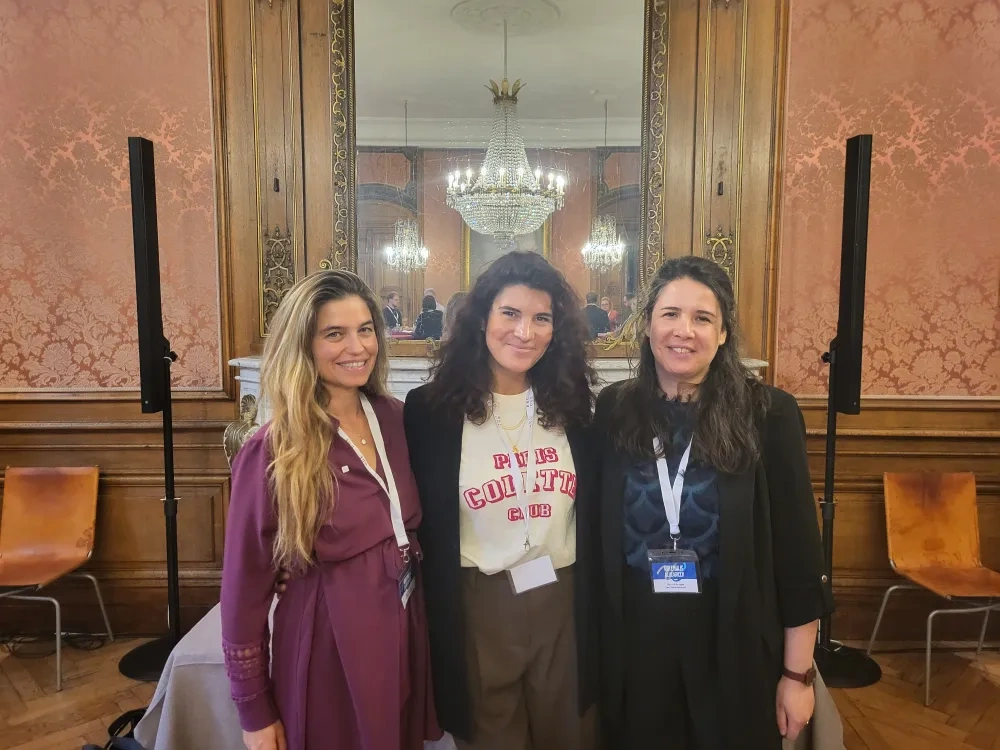
Astrid Stroobandt (centre) and her team are leading the transformations in Blue4Green.
From the left:
- Magalie Mahieu makes sure thatBlue4Green’s messages are communicated to all relevant audiences.
- Astrid Stroobandt is the project lead for Blue4Green and has all the superpowers for leading change in Bruges by connecting people across teams and disciplines.
- Ilse Vansevenant keeps the transfer partners in the loop and makes sure the numbers add up.
Not in the picture:
- Eva Gheselle keeps an eye on the water flows in Bruges as the city’s hydrologist.
- Kris Taillaert, the city's geographic information system (GIS) coordinator, connects blue and green data with geographic reference points.
- Tom Boi shares Kris' enthusiasm about GIS and for how data can shape evidence based policy making.
- Jonas Lagrou is a critical friend who has become more of a BFF who links Blue4Green to similar European projects and ensures cross-pollination. Officially, he is a policy officer at the City of Bruges.
- Jolien Mespreuve is the coordinator of European projects in Bruges, always on the lookout for new opportunities.
Key insights from the first year
The first year of Blue4Green was a period of laying the foundations for long-term change for the team: from installing sensors that reveal the city’s hidden water flows, engaging residents in co-creation, securing strong political support, to transforming scattered data into actionable insights. Here are some of the most important insights from the year:
#1: Sensors are making Bruges’ hidden flows visible
The project partners iFlux and the University of Ghent installed sensors to collect essential data for evidence-based policy decisions related to the city’s water bodies and green spaces.
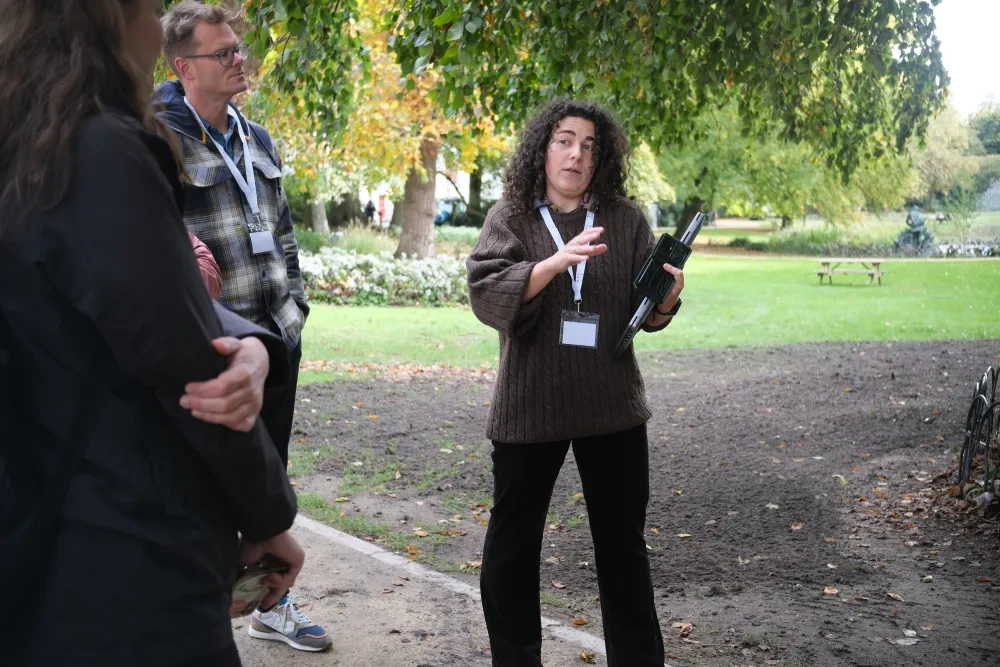
Aurélie Vandenbussche explaining the tree sensor in Astridpark to the Blue4Green transfer partners. Photo: Johannes Riegler
In Astridpark, the University of Ghent installed a sensor on a tree to measure sap flow, the hydraulic function of the tree, and the tree’s growth in real time. The team can now observe in real time whether it suffers from water shortage and needs irrigation, or whether it is in good condition.
The data are not only a resource for scientists; everyone can observe how the tree is doing. By visiting https://treewatch.net/be-brugge/ the data are illustrated in real time.
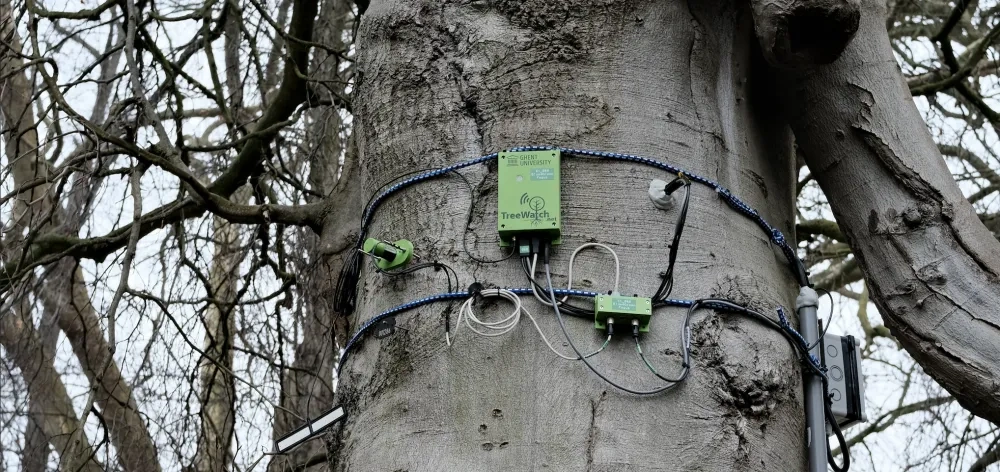
How to understand a tree? By adding a sensor. Photo: Johannes Riegler
Beneath the feet of the Bruggelingen, the groundwater is a dynamic water system that often goes unnoticed. In 2025, iFlux, one of the project’s technology providers, started installing sensors in the ground. These sensors reach down into the soil, providing a 360-degree perspective of the groundwater flows. The sensors provide insight into the hydrology beneath the surface, showing where water flows, pools, and vanishes. Blue4Green will install a total of 40 sensors at key locations that continuously monitor groundwater levels.
With the information we gain from the sensor data, we can target irrigation precisely. When heavy rains hit, we will know exactly where to buffer the water first. The sensors are a crucial step in climate-proofing Bruges,
Franky Demon, City of Bruges Alderman for Public Space.
By combining above and below-ground monitoring, Bruges is building a real-time understanding of its hydrology and ecology, turning data into action.
#2: Engaging the community
While Blue4Green has a strong focus on technological solutions, governance innovation, and data-driven decision-making, engaging residents across age and social groups has been a key activity. Waterland, an NGO and project partner, is designing various activities to create awareness of Blue4Green and invite the community to co-creation activities as climate adaptation starts in the street but extends into private gardens. Through garden coaches, residents are supported in making their gardens more climate-robust, guided by the ambition of letting every drop of water infiltrate where it falls.
In June, they brought climate action to the streets with the Klimaat Kiosk which became the centre of different activities. The team invited residents of the Magdalena neighbourhood to manage water more effectively in their gardens. The neighborhood is a heat island (a phenomenon where cities or built-up areas become significantly warmer than nearby rural areas) , despite its location close to the water and the Astridpark.
“Waterland feels completely at home in a water city like Bruges. In the Magdalena district, we are exploring both large and small measures to give water and greenery more space in a densely built environment. We also experiment with additional functions and pay attention to water quality along the water’s edge. By planting this tree, we invite residents of the neighbourhood to join in. Any idea or place where people want to get started is welcome.” explains Lieven Symons of Waterland.
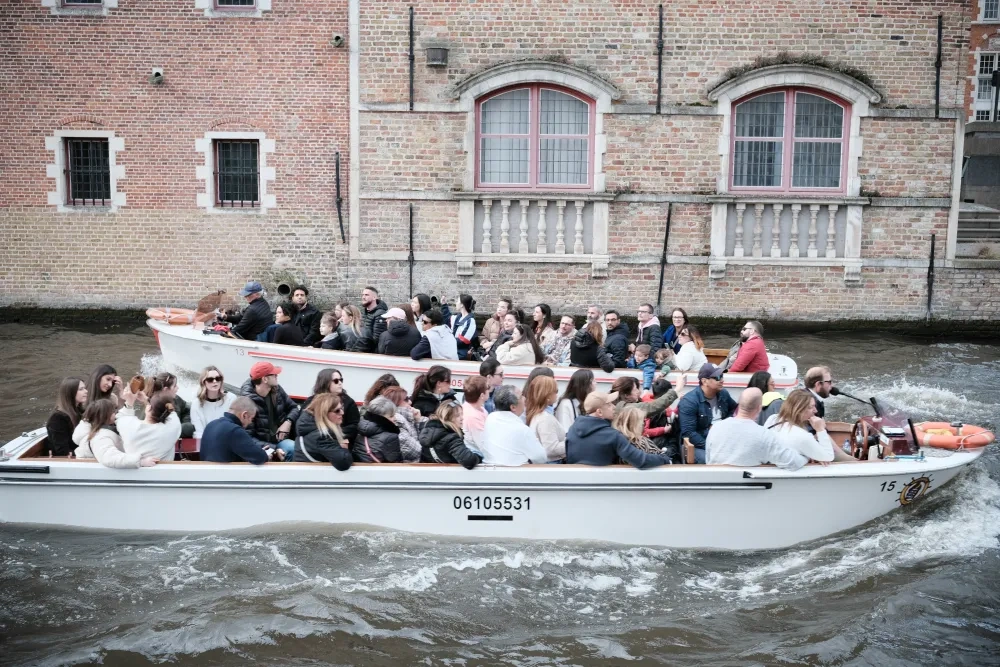
Blue4Green will ensure that the residents of Bruges can experience and benefit from the vicinity to the water everyday. Currently, tourist boats dominate the access to the water in the canals. Photo: Johannes Riegler
Later in the summer, the team organised visioning workshops with schoolchildren, which aimed to collect their dreams and wishes about living with water in Bruges.
Find out more about Waterland’s work in Blue4Green in the podcast episode: Reimagining Bruges: Water, green spaces and community.
Raising awareness among the residents is not only about saving water effectively but also about strengthening community ties and laying the groundwork for co-creating future Blue4Green interventions.
#3: Securing political and institutional backing
Political backing is essential for ambitious urban transformation projects. Blue4Green has earned strong political support due to its alignment with clean water goals and the high visibility in public communications (if you live in Bruges, make sure to have a look at the Brugge Stadmagazine to catch regular updates on Blue4Green). It contributes to the public understanding that canals, historic buildings and public spaces are recognised as places for innovation and forward-looking urban governance. The political support suggests that Bruges is ready to take big steps: not only to respond to immediate water challenges but also to lead in imagining how historic cities can adapt to climate-change-related pressures.
#4: Laying the groundwork for data-driven water governance
In the first year, the project team succeeded in creating the foundation for a new way of managing water in Bruges, even though they faced challenges related to incoherent and scattered data (find out more in the challenge section below). However, the team succeeded in creating a foundation for a new way of managing water in Bruges. Data sets were georeferenced (meaning that geographic coordinates were added to be able to illustrate the data on a map), cleaned, structured, and integrated. Static Excel sheets were transformed into interpretable data, which will be used for the Blue4Green dashboard and evidence-based policymaking. Within the city administration, the project raised awareness of data as the basis for policy development, fostering stronger collaboration between data teams and decision-makers. The team induced a meaningful shift where information and data are gathered more effectively and used as a source for shaping a resilient and climate-ready city.
Lessons learned throughout the project
Although 12 months in a large-scale project might seem short, the Blue4Green team derived important lessons and built capacities which will have a lasting impact in the city, even beyond the end of the project. From making sense of long-term data, to bridging city departments, teamwork, and the importance of persistence, there are various learnings which will be anchored for long-term change in the city administration of Bruges and provide important insights for those looking to learn from the experiences.
#1: Data works as a transformative learning process rather than a technical task
One central innovative solution of Blue4Green is the digital twin and the connected smart water steering system, which will control the inlet and outlet of the canal system. Both will become a reality in the next phases of the project. In the first year, the team made progress in bringing together various data points and interpreting data collected over the past 20 years in novel ways.
When meeting Kris Taillaert and Tom Boi, the data experts on the project, the team immediately began discussing how exciting the work is for them and what new opportunities it presents.
After the first year, Kris and Tom also highlighted that working with data is much more than a technical and isolated task. It required deep engagement and understanding of various datasets, for example, long-term water quality data. It also requires self-learning on how to process the data, which at times can be a frustrating trial-and-error experience, yet it builds skills within the local public administration and shapes new abilities that benefit various city services. The first year of Blue4Green shows that innovation in urban governance related to data often does not rely solely on new tools but on developing internal capacities to understand, interpret and trust data over time.
#2: Working side-by-side triggers governance innovation
One key learning from the first year that the team was eager to share was their realisation that working together in the same space is an innovation in itself, which often goes unnoticed. Periods of co-working accelerate the understanding of different perspectives, ambitions, and knowledge, shorten feedback loops, and bridge disciplinary gaps. It might seem like a simple task, yet it is profoundly transformative: bringing people together is a powerful enabler of innovation.
#3: Persistence as a form of leading change across city departments
Driving change in public administration can be a difficult task. When you try to make changes in an organisation, several factors contribute to this challenge: bureaucratic structures, hierarchies, standardised procedures and well-established ways of working. Yet, EUI Innovative Actions are characterised by the need to adapt internal structures and procedures to the transformations the projects are driving.
The first year of Blue4Green showed how important it is to be aware of the human side of transformation for navigating the terrain and leading change within the administration. Astrid Stroobandt and her team learned from the early days of the project that taking everyone on board is key: listening to concerns, taking them seriously, co-creating ways forward and, very importantly, building personal connections and trust.
In Blue4Green, teamwork across departments and with our other partners is an active practice rather than an organisational given,
says Astrid Stroobandt when asked how she, as the project manager, is making sure that the project is anchored across various city departments and services: from IT and data, to public spaces and properties, green infrastructures, water management and even archaeology.
#4: Local change can gain international recognition
Besides the local impacts, Blue4Green has been recognised internationally as an example of how world heritage cities can transform their infrastructures and ensure they meet the challenges caused by climate change.
Throughout 2025, the team joined several workshops and conferences to inspire other cities with the solutions experimented with in Bruges. From the European Placemaking Week in Reggio Emilia to the Cities Forum, the Blue4Green team spread the message and ensured that other cities could take Bruges as a role model in their plans to rethink the connections between water management and green spaces.
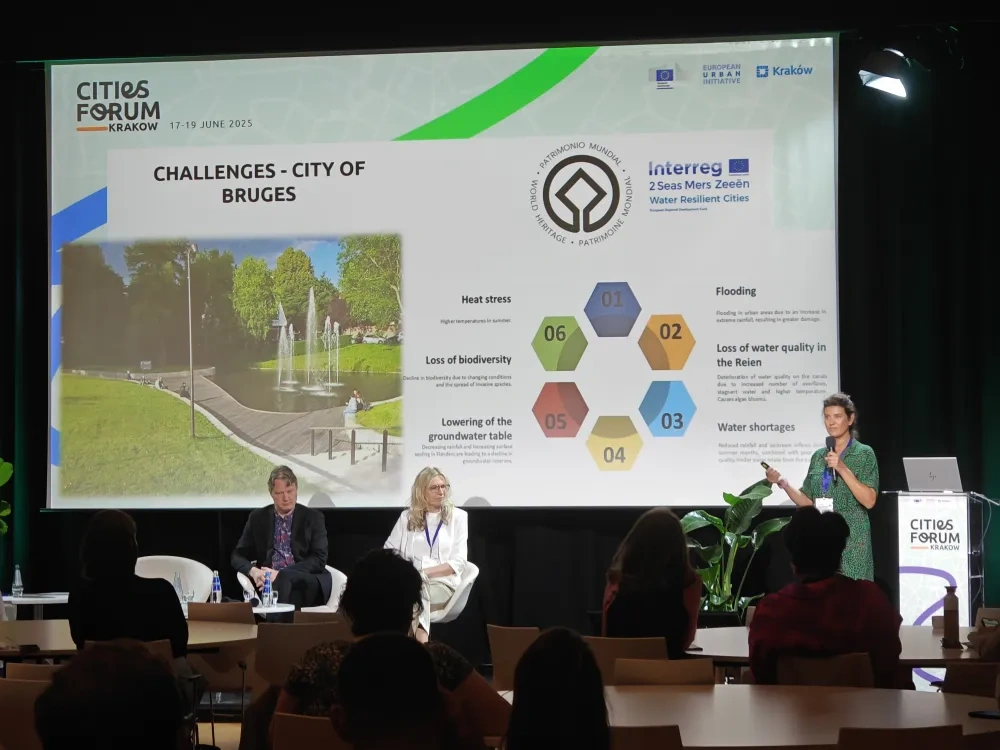
Astrid presenting Blue4Green at the Cities Forum in Krakow in June 2025.
In October, delegations from the Cities of Utrecht in the Netherlands, Písek in the Czech Republic, and Aveiro in Portugal visited Bruges to learn more about the approaches, solutions, and experiences of Blue4Green. The three cities are the project’s transfer partners. Each transfer city faces different challenges related to water, from blue and green algae plagues to ensuring access to water for its residents. In the next steps, the transfer cities will explore how they can benefit by replicating selected parts of the Blue4Green project in their own contexts. In 2026, Transfer Expert Ruxandra Aelenei will continue connecting the cities and their experiences. The cities will also start visiting each other before returning to Bruges for a deep dive into the learnings of Blue4Green.
While Blue4Green is a local effort to future-proof the city’s water systems, it has become a shared European reference point already in the first year of the project, showing how place-based change can inspire beyond Bruges canals and city limits.
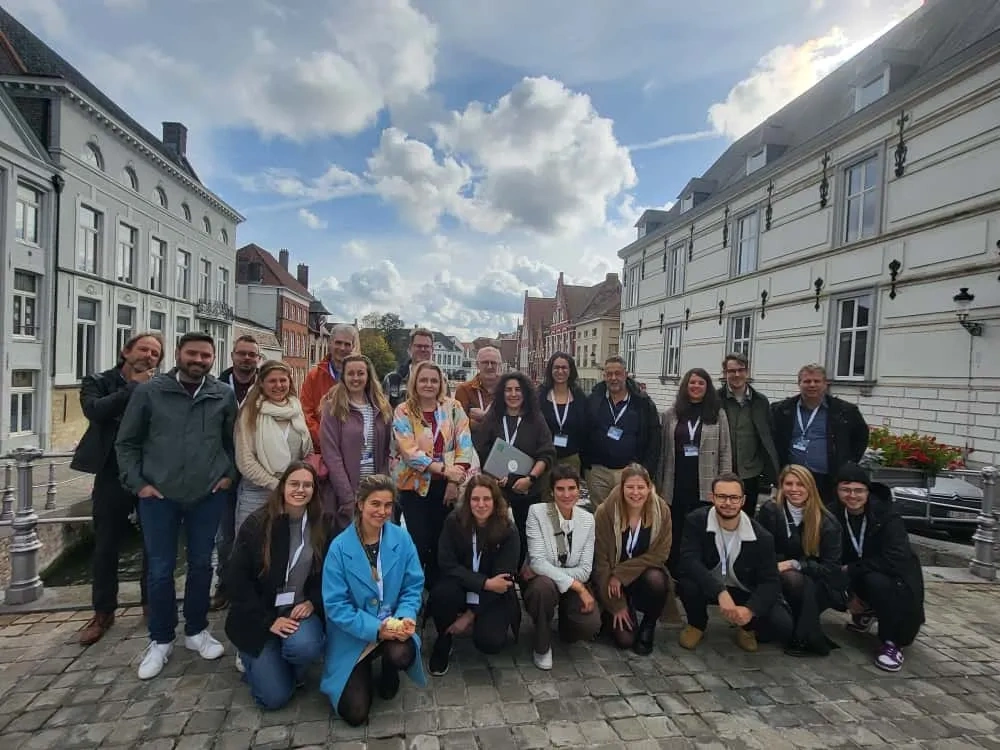
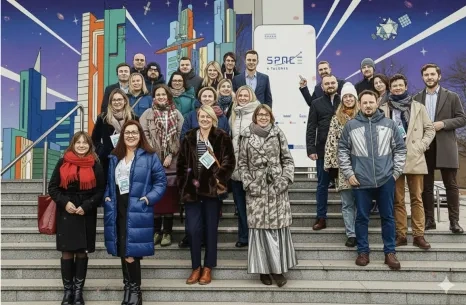
The Blue4Green team with the transfer cities and EUI representatives in October 2025.
Blue4Green and the City of Bruges are on their way to contributing to important European debates while inspiring others to follow in the city’s footsteps. The groundwork laid in 2025 was just the beginning. In November 2026, European experts, city administrations, policymakers, and others will flock to Bruges as the city becomes the stage for an EUI Focused Policy Lab on Water Management in Cities.
Challenges of the first year
If an EUI Innovative Action did not have to face a diverse set of challenges, it would probably not be innovative enough. Transformative projects cause friction among stakeholders, within organisations, and with the public. But can such challenges be addressed? The key to unlocking the full potential of such a project is not to avoid challenges and conflicts, but to know how to sail the bumpy waters. In 2025, the project team faced various storms, from the emergence of a blue and green algae plague in the summer to internal resistance to different working speeds, and much more. Yet, Astrid and her team made sure to sail to calmer waters and be prepared for the next headwinds.
# 1: When heat, water quality and heritage collide
It had been planned for a long time: the Urban Swim event on 14 June, when the swimming area was opened to the public. Have a look at how much fun it was here. However, this summer the joy lasted only a couple of weeks, as the swimming zone had to be closed on 11 July due to an intense outbreak of toxic blue-green algae, a phenomenon resulting from high water temperatures and poor water quality. The blooms pose a serious health risk for humans and animals, and the famous swans of Bruges (read about the city’s legend of the swans here) were taken into quarantine.
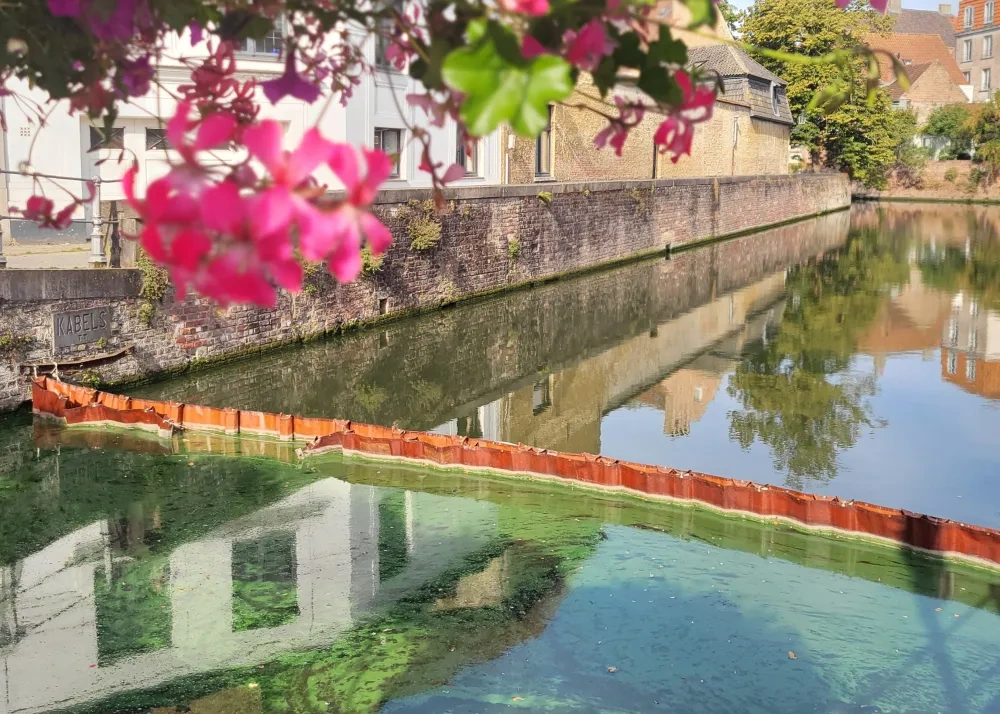
The blue-green algae plague of the summer 2025. Photo: City of Bruges
The City of Bruges, together with the project partner University of Ghent, took immediate action to find novel water treatment solutions. Initially, the project aimed to prevent algae blooms before they happened, yet in the summer of 2025, it provided a springboard for experimentation on what to do once it is there.
The algae crisis of 2025 underlined the importance of the ambitions of Blue4Green and its work to make Bruges’ canals future-proof (and the swans happy). The project’s work gained significant media coverage throughout the summer and contributed to public awareness of water in the city.
Read more about how the summer of 2025 was a wake-up call for the City of Bruges here.
#2: Connecting the dots and bridging a patchwork of data on water
Data is only worth as much as the connections you make and how you interpret them. Prior to Blue4Green, data about water quality and other relevant indicators were tucked away in Excel sheets and databases. Kris Taillaert and Tom Boi, the project’s data experts, had to turn the data into usable and interoperable information that could serve the purpose of Blue4Green.
In the past, it was not possible to interpret the latest data points of water samples due to a lack of capacity for analysis. There was a missing link between collecting data and having the tools to interpret it.
Addressing this challenge from early on in the project has been essential for turning this patchwork of data points into information that can be used for the policy and citizen dashboards Blue4Green will develop. The challenge shows that, in making a change, technology rarely limits progress, but legacy practices, siloed information, and fragmented processes present a bottleneck.
Data that was scattered across departments and files is now coming together to be used for evidence-based decision-making related to water and green spaces in Bruges. The team connected water quality data with geographic data, providing the basis for the dashboard. The next step for the team is to translate this new information, which currently can mainly be interpreted by experts, into input for the citizen dashboard.
#3: Working at different speeds across project partners
Innovative actions follow tight schedules and timelines. Delays at the beginning will cause timing issues later. While Blue4Green operates within a fixed timeline, many project partners are used to longer project cycles. This mismatch is amplified by different working modes and technical jargon, resulting in frustration among the project’s core team. The challenge illustrates the tension between innovation-driven work and established practices.
The team of the City of Bruges will need to continue reminding project partners of the urgency of keeping to the timeline, as not everyone is familiar with the project’s technical jargon.
#4: Reliance on unwritten knowledge within the local administration
Every institution has them: people who seem to make processes work and know how to get things done. They often have specific knowledge accumulated over years, in many cases decades. While these people are treasures for every organisation, it becomes a challenge if tacit knowledge is held entirely by individuals rather than documented and broadly accessible. In the first year of Blue4Green, the project team had to adapt and revise plans as essential information only surfaced after meetings. This extra effort demanded additional coordination and slowed the process. Knowledge and capacities that are not formalised need to be translated from individual expertise into a shared institutional memory.
The challenge they faced at the beginning of Blue4Green serves as a reminder that experimenting with novel approaches and technical solutions is not enough. The results and newly developed knowledge and skills need to be anchored within the institution to build capacities beyond the project’s end.
Looking ahead: Bruges’ journey to water resilience
The core team of the City of Bruges laid the groundwork for fully unfolding the ambitions of the Blue4Green project over the coming years. It demonstrated that setting up the basics for transformation is not only about implementing technological solutions, but also about people, processes, and persistence. From the installation of the first real-time sensors to engaging residents in co-creation activities and bridging different city departments, the team succeeded in showing how water resilience is a collective journey.
Before smart systems are in place, data needs to be collected from scattered sources, processed, and cleaned before it can be used to derive information for decision-making. Collaborations across departments are essential to drive change, which requires project leadership that understands the human side of urban transformations.
On a larger scale, Blue4Green has set a strong foundation for informing European debates on climate adaptation and urban sustainability. Throughout the year, the team has already begun to inspire cities across Europe at conferences and through the project’s transfer activities.
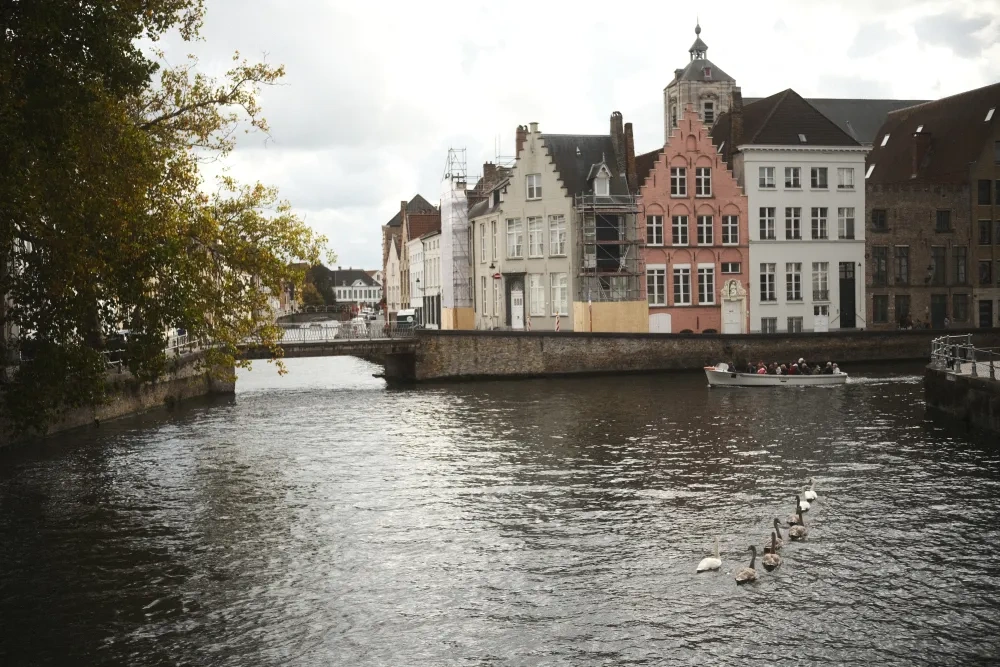
Bruges: Water, swans, cultural heritage. Photo: Johannes Riegler
The foundations laid in the first year are just the beginning. In 2026, the team will continue to connect blue and green spaces, involve residents in the journey, link and collect new data, and start construction of a smart steering system: automated sluices at the canal’s inlet and outlet, informed by a policy dashboard. Exciting times are ahead.
If you would like to find out more about how Blue4Green will continue to shape life in and around Bruges’ canals, do not miss future articles, podcasts, and other outputs published on Portico.
About this resource
The European Urban Initiative is an essential tool of the urban dimension of Cohesion Policy for the 2021-2027 programming period. The initiative established by the European Union supports cities of all sizes, to build their capacity and knowledge, to support innovation and develop transferable and scalable innovative solutions to urban challenges of EU relevance.

Similar content